Introduction
Gujarat Data Centre Policy 2026 explained for Dholera: understand eligible entities, the 150 MW approved IT-load requirement, eligible investment, Dholera-specific support and what private land buyers still need to verify.
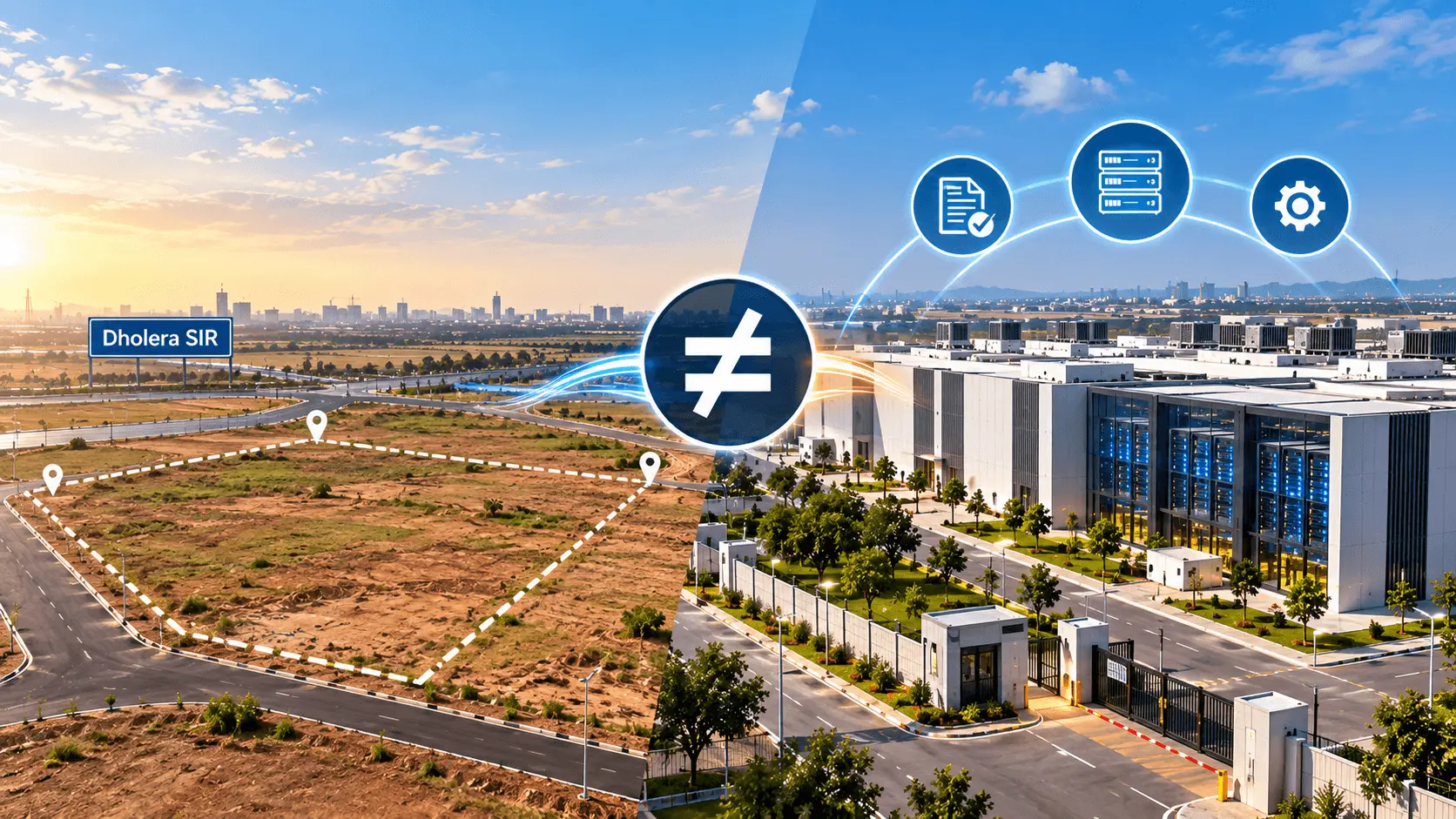
Gujarat’s new data-centre policy has created fresh interest around large digital-infrastructure projects, and Dholera has a specific place in the policy. However, for property buyers and landowners, there is an important distinction to understand from the beginning: a government policy supporting data centres is not the same thing as a blanket incentive attached to every plot of land in Dholera.
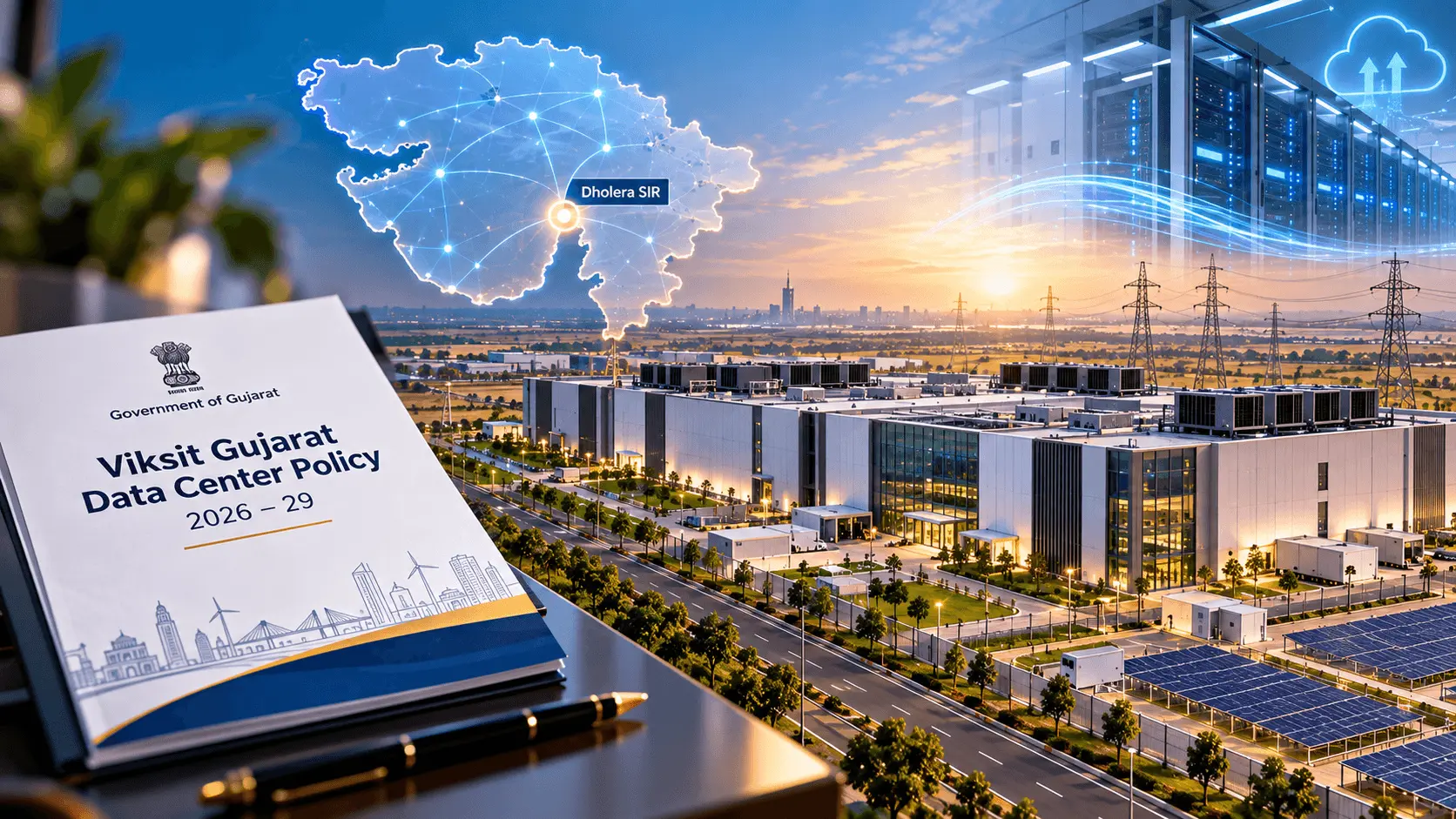
The Government of Gujarat’s Department of Science and Technology has issued the Viksit Gujarat Data Center Policy (2026–29) with the broader objective of building a hyperscale-ready data-centre ecosystem in the state. The official policy document states a target of establishing 7.5 GW of data-centre capacity in Gujarat, while also setting out definitions, investment criteria, power and sustainability conditions, project-level eligibility requirements and fiscal as well as non-fiscal support.
For Dholera, one provision deserves particular attention: the policy provides a 2.5% capital subsidy on Eligible Fixed Capital Investment, or EFCI, applicable only for the Dholera Region. But that sentence should not be separated from the rest of the policy. The same document later states that only data-centre projects having an approved installed IT load capacity of 150 MW or above are eligible under the policy.
This means the correct question for a property buyer is not simply, “Does my land fall in Dholera?” A more useful question is: Could a proposed project on this land satisfy the applicable planning, infrastructure and policy requirements for a qualifying data-centre project?
That distinction is the focus of this article.
What Is the Viksit Gujarat Data Center Policy 2026–29?
The Viksit Gujarat Data Center Policy (2026–29) is a Government of Gujarat policy administered through the Department of Science and Technology. According to the official document, its vision is to position Gujarat as a major destination for hyperscale and AI-oriented data-centre infrastructure, supported by reliable energy, digital connectivity, sustainability measures and an investment framework designed for large-scale projects.
The official PDF records 6 August 2026 as its approved date. The policy states that it will remain operative for three years unless replaced or extended earlier, and it provides that eligible entities applying within the policy period must receive in-principle approval within the prescribed timeframe. The document specifically refers to 5 August 2029 in relation to in-principle approval eligibility.
The policy also sets a statewide target of 7.5 GW of installed data-centre capacity. This is a policy target for Gujarat’s data-centre ecosystem. It should not be interpreted as 7.5 GW already sanctioned, constructed or committed to Dholera, and it certainly does not mean that every land parcel within Dholera becomes eligible for a data-centre incentive simply because the statewide target exists. Clause 7.9 further states that policy incentives and support are available for projects only up to an aggregate installed-capacity target of 7.5 GW in the state.
Which Entities Can Apply Under the Gujarat Data Centre Policy?
The policy uses the term “Data Center Entity” rather than limiting participation to one particular corporate structure. Its definition includes a company, Special Purpose Vehicle, partnership, trust, body corporate or another legally recognised organisation that owns, leases, develops, establishes, holds or controls the land, building or core infrastructure of a data centre or integrated data-centre park. It may act directly or through subsidiaries, affiliates or group entities and may be responsible for development, investment, operation, sub-leasing, management or overall administration of the project.
That broad definition is useful, but it should not be read in isolation. Being a company, SPV, partnership or landholding entity does not automatically make a project eligible for assistance. The project must also satisfy the other conditions contained in the policy, including the installed IT-load threshold and whatever approvals are required under the policy implementation process.
The policy additionally allows Fixed Capital Investment and Eligible Fixed Capital Investment to be made through arrangements involving a JV, SPV, subsidiary, affiliate, developer, operator or user entity, or a combination of these. Such investments may be aggregated for eligibility and incentive calculations, but this remains subject to the prescribed eligibility conditions and approval of the High-Powered Committee.
For a landowner, therefore, merely owning a parcel that could theoretically host a data-centre project is different from becoming an approved Data Center Entity under the policy.
What Does “Approved Installed IT Load of 150 MW” Mean for Eligibility?
One of the most important clauses in the entire policy is Clause 7.6. It states that only data-centre projects with an approved installed IT load capacity of 150 MW or above shall be eligible under the policy.
This figure should not be confused with plot area, general electricity availability in a locality or the overall electrical load associated with every component of a development. In data-centre planning, IT load relates to the power capacity associated with the computing and information-technology infrastructure that the data centre is designed to support.
The word “approved” is equally important. A proposed capacity written in a business plan, marketing presentation or land-sale document should not be treated as equivalent to an approved installed IT load. The policy uses a specific eligibility threshold and places applications within a formal approval framework involving the Government and the High-Powered Committee.
Therefore, if a land parcel is being marketed on the basis that it is “data-centre suitable” or “eligible under the Gujarat data-centre policy,” the buyer should ask for the basis of that statement. Is there an actual proposed data-centre entity? What installed IT load is proposed? Has the capacity relevant to policy eligibility been approved? Has an application been submitted, and is there any in-principle approval?
Without those project-level facts, the policy should not be used as evidence that a normal private land purchase itself qualifies for government assistance.

What Is Eligible Fixed Capital Investment Under the Policy?
The definition of Eligible Fixed Capital Investment, or EFCI, is particularly relevant for property buyers because the policy specifically separates qualifying project infrastructure from the value of the underlying land.
According to the official policy, EFCI can include expenditure on core technical infrastructure such as buildings and civil construction, electrical systems, mechanical and cooling systems, power-backup infrastructure, captive Battery Energy Storage Systems, data-centre-specific equipment, networking and cabling, security systems, fire-safety installations and other essential fixed systems required to make the data centre operational.
However, the policy expressly excludes the cost of land, land development and semiconductor chips from EFCI. It also limits EFCI considered under the policy to 80% of total Fixed Capital Investment or ₹60,000 crore, whichever is lower, for a 1 GW project, with the ceiling adjusted proportionately for projects of different approved capacities.
This is a critical distinction for real-estate communication. If someone purchases a private plot in the Dholera region, the purchase price of that land does not automatically become EFCI merely because a data-centre policy exists. The policy is designed around investment in an approved data-centre project and its eligible fixed infrastructure.
What Provision Specifically Refers to Dholera?
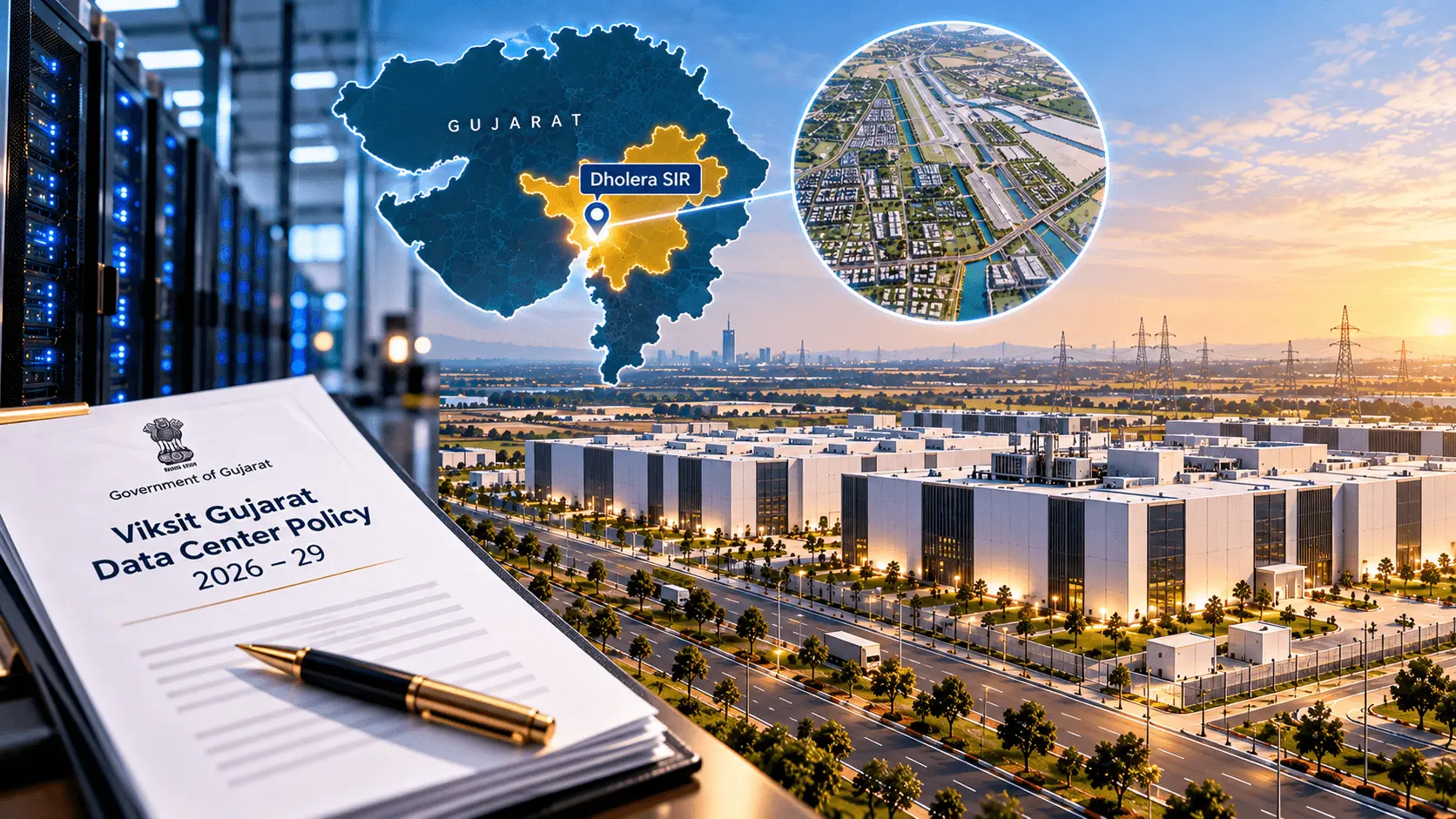
The most direct Dholera-specific financial provision appears under the policy’s incentives section. It provides a capital subsidy of 2.5% of Eligible Fixed Capital Investment, and expressly states that this capital subsidy is applicable only for the Dholera Region. The policy also provides that an eligible data-centre entity may submit claims for this incentive for up to ten years from the date of grant of in-principle approval.
The practical wording here matters. The subsidy is calculated on Eligible Fixed Capital Investment, not simply on the market price of land. It is available to an eligible data-centre entity, rather than being described as a benefit automatically attached to any property transaction.
The policy document does not provide, within this particular incentive row, a parcel-by-parcel definition of what a property seller may call the “Dholera Region.” Therefore, a buyer considering an actual parcel should not use a marketing location label as the final proof of policy eligibility. The exact site, planning jurisdiction, proposed activity and government approval position still need to be established independently.
Dholera itself is a formally planned Special Investment Region. Government of India material describes
Dholera SIR as an approximately 920 sq. km planned region with its developable area organised through multiple Town Planning Schemes. That planning context is another reason why exact land location and permitted use matter more than a broad “Dholera” address.
Are There Other Incentives Besides the Dholera Capital Subsidy?
Yes. The policy contains several other forms of support, but they should still be read as components of an approved project framework rather than as a property-sales package.
The official policy provides for an interest subsidy of up to 4% for ten years, capped at ₹25 crore per year on the eligible term-loan portion used for Fixed Capital Investment. It also provides power-tariff reimbursement of ₹1 per unit for twenty years from commencement of commercial operations, reimbursement provisions relating to stamp duty and registration fees, electricity duty and specified SGST components, subject to the detailed policy conditions.
The policy also contains non-fiscal and development-related provisions covering matters such as additional FSI subject to applicable local Development Control Regulations, parking norms, utilities and transformer arrangements, ground coverage, rooftop chillers, boundary walls, fire-safety requirements, open-access power procurement, dual power-supply facilitation and statutory-clearance support.
These provisions make the policy relevant to project planning, but they do not remove the need to satisfy local planning rules, technical feasibility, utility requirements and statutory approvals for the actual site.
What Does the Policy Say About Power, Renewable Energy and Water?
Data centres are unusually power-intensive developments, so power supply is not a secondary consideration under the Gujarat policy.
Clause 7.1 requires a Data Center Entity to ensure that at least 51% of electricity consumption for core data-centre operations is sourced from green and renewable energy. The policy also permits procurement through Open Access according to prevailing regulations and provides for facilitation of dual power supply through independent and electrically diverse incoming feeders, where applicable.
Water is also addressed. The policy provides for round-the-clock water availability up to the doorstep of eligible data-centre entities and includes support for captive desalination plants. Clause 7.11 further says data-centre entities are expected to establish captive desalination facilities and meet their water requirements primarily through them wherever feasible while availing policy benefits.
For site selection, this means a parcel cannot be evaluated only by acreage and road frontage. Large data-centre development involves a combined assessment of electrical capacity, redundancy, renewable-energy strategy, water, cooling, planning controls, fire safety, network connectivity and project approvals.
The engineering side of those questions deserves a separate site-selection analysis. This article remains focused on policy eligibility.
Does Buying Land in Dholera Automatically Qualify for the Policy?
No such automatic entitlement appears in the policy.
A land purchase and an approved data-centre project are two different things. The policy identifies an eligible Data Center Entity, defines EFCI, requires a minimum approved installed IT load of 150 MW and establishes a government approval and incentive-disbursement framework. It also expressly excludes land cost and land-development cost from EFCI.
That is why a statement such as “this plot receives Gujarat data-centre subsidy because it is in Dholera” would be incomplete unless it is supported by the project-level eligibility and approval facts required under the policy.
A plot can still be commercially interesting for many reasons, but those reasons should be evaluated separately from government-policy eligibility. Policy eligibility belongs to the qualifying project; it should not be treated as a permanent feature embedded in every parcel of land.
What Does the 7.5 GW Target Actually Mean?
The figure 7.5 GW is one of the largest numbers associated with the policy, which also makes it easy to misinterpret.
The policy describes 7.5 GW as Gujarat’s target for establishment of data-centre capacity and later limits incentives and support to projects within an aggregate installed-capacity target of 7.5 GW across the state.
It is therefore best understood as a state-level policy capacity target, rather than as an announcement that 7.5 GW of data centres have already been approved or committed.
It also should not be converted into a land-price forecast.
A statewide digital-infrastructure target may influence future infrastructure planning and investor attention, but the effect on an individual property’s value depends on many separate factors, including location, zoning, title, access, development permissions, surrounding projects, infrastructure delivery and actual market demand.

Why Is the Dholera Provision Relevant to Real Estate Without Becoming a Land-Sales Claim?
The policy matters to Dholera because it gives the region a clearly identified role within Gujarat’s data-centre strategy. A Dholera-specific capital-subsidy provision means policymakers are differentiating the region within the statewide incentive framework.
For real estate, that can be relevant when studying the types of large-scale economic activities that may be considered for the region over the long term.
But there is a line between regional policy relevance and individual property eligibility.
A policy may improve the institutional case for attracting a particular industry without guaranteeing that every nearby parcel will host that industry, receive the associated subsidy or appreciate because of it. For buyers, the better approach is to start with the official policy and then work down to the exact project, exact planning zone and exact land parcel.
That is a more reliable way to evaluate Dholera than starting with an incentive headline and working backwards to justify a property purchase.
Which Entities Can Apply Under the Policy?
A company, SPV, partnership, trust, body corporate or another legally recognised organisation may fall within the policy’s definition of a Data Center Entity where it owns, leases, develops, establishes, controls or administers the relevant data-centre land, building or core infrastructure. However, the entity must also satisfy the policy’s other eligibility conditions; organisational form alone is not sufficient.
What Does Approved IT Load Mean for Eligibility?
The policy requires an approved installed IT load capacity of at least 150 MW. This is a project-level eligibility condition. A proposed or advertised electrical figure should not automatically be treated as approved IT load unless the appropriate project documentation supports it.
Which Provisions Specifically Refer to the Dholera Region?
The most direct Dholera-specific clause is the capital-subsidy provision: 2.5% of Eligible Fixed Capital Investment for eligible Data Center Entities in the Dholera Region. The subsidy is based on eligible project investment, not simply on the purchase price of land.
What Does a Private Plot Buyer Still Need to Verify Independently?
A private buyer should independently verify the exact parcel identity, ownership and title record, encumbrances, planning and land-use position, TP/FP or Survey details, road access, utility feasibility and any project-specific approvals. If the land is being promoted specifically for a data centre, the buyer should also establish how the proposed project could meet the minimum 150 MW approved IT-load requirement and whether any policy application or in-principle approval actually exists. Gujarat’s Revenue Department provides official services for several core land and registration checks.
Frequently Asked Questions
Conclusion
The
Viksit Gujarat Data Center Policy (2026–29) gives Dholera a specific position in Gujarat’s digital-infrastructure strategy, but its provisions need to be read at project level rather than converted into a general property-sales claim.
The policy targets up to 7.5 GW of data-centre capacity across Gujarat, defines the organisations that can operate as Data Center Entities, establishes Eligible Fixed Capital Investment rules and requires a minimum approved installed IT load of 150 MW for project eligibility. For the Dholera Region, it additionally provides a 2.5% capital subsidy on EFCI for eligible projects.
For a private property buyer, the most important distinction is straightforward: being located in Dholera and qualifying under the Data Center Policy are not the same thing.
Land cost itself is excluded from EFCI. A buyer therefore still needs to independently check the exact Survey or Final Plot, title and registration records, planning and permitted-use position, road access, infrastructure feasibility and, where a data-centre project is proposed, the required IT-load and government-approval position.
That approach keeps the discussion grounded in the official policy and in the actual property rather than treating a statewide infrastructure target as a promise attached to every piece of land.
Official Sources & Records
This article has been prepared using publicly available official government records and policy documents. The primary source is the Viksit Gujarat Data Center Policy (2026–29) issued by the
Department of Science and Technology, Government of Gujarat, under G.R. No. DST/MIT/e-file/24/2026/0624/IT. The official policy document records an approved date of 6 August 2026, while the Department’s Government Resolution index lists the policy entry dated 7 August 2026. The policy document has been used for references relating to eligible Data Center Entities, Eligible Fixed Capital Investment (EFCI), the minimum approved installed IT load requirement, policy incentives, the 7.5 GW state capacity target and the Dholera-specific capital subsidy provision.
For Dholera SIR background and development context, this article refers to the official National Industrial Corridor Development Corporation (NICDC) project information for Dholera Special Investment Region. NICDC describes Dholera SIR as a planned industrial smart city spanning approximately 920 sq. km and identifies the 22.54 sq. km Activation Area and its infrastructure-development context.
Disclaimera
This article is published for general informational and educational purposes and is based on publicly available government policies, records and official sources available at the time of writing. It should not be treated as legal, financial, tax, engineering, investment or government-approval advice.
References to the Gujarat Data Center Policy, Dholera SIR, incentives, subsidies, infrastructure or eligibility conditions do not mean that any particular private plot, land parcel, owner, developer or proposed project automatically qualifies for benefits under the policy. Eligibility is project-specific and remains subject to the conditions, approvals, documentation and decisions of the competent government authorities.
Before purchasing or investing in any property, buyers should independently verify the exact Survey Number, Block Number or Final Plot details, ownership and title, mutation entries, encumbrances, Town Planning Scheme status, zoning and permitted land use, NA/NOC or other applicable permissions, authorised access,
development controls, utility feasibility and any project-specific approvals.
Where a property is promoted for data-centre use, buyers should additionally verify the proposed Data Center Entity, approved installed IT load, power and infrastructure feasibility, in-principle approval and eligibility for incentives directly from the appropriate government authorities. The Viksit Gujarat Data Center Policy currently specifies that only projects with an approved installed IT load of 150 MW or above are eligible under the policy, while the Dholera-specific capital subsidy is linked to Eligible Fixed Capital Investment, not automatically to the purchase value of an ordinary land parcel.
Dholera City Buildconz does not guarantee government approval, policy eligibility, subsidy entitlement, infrastructure completion, future property appreciation, rental income or investment returns. Government policies, regulations, planning provisions, incentives and administrative procedures may be amended, clarified, extended, withdrawn or replaced. In case of any difference between this article and an official government notification,
Government Resolution, policy document, order or subsequently amended provision, the latest applicable official government record should prevail.