Introduction
A 300-square-metre plot does not automatically mean you can construct a 300-square-metre building
on the ground.
It also does not tell you, by itself, how much total floor area may eventually be permitted.
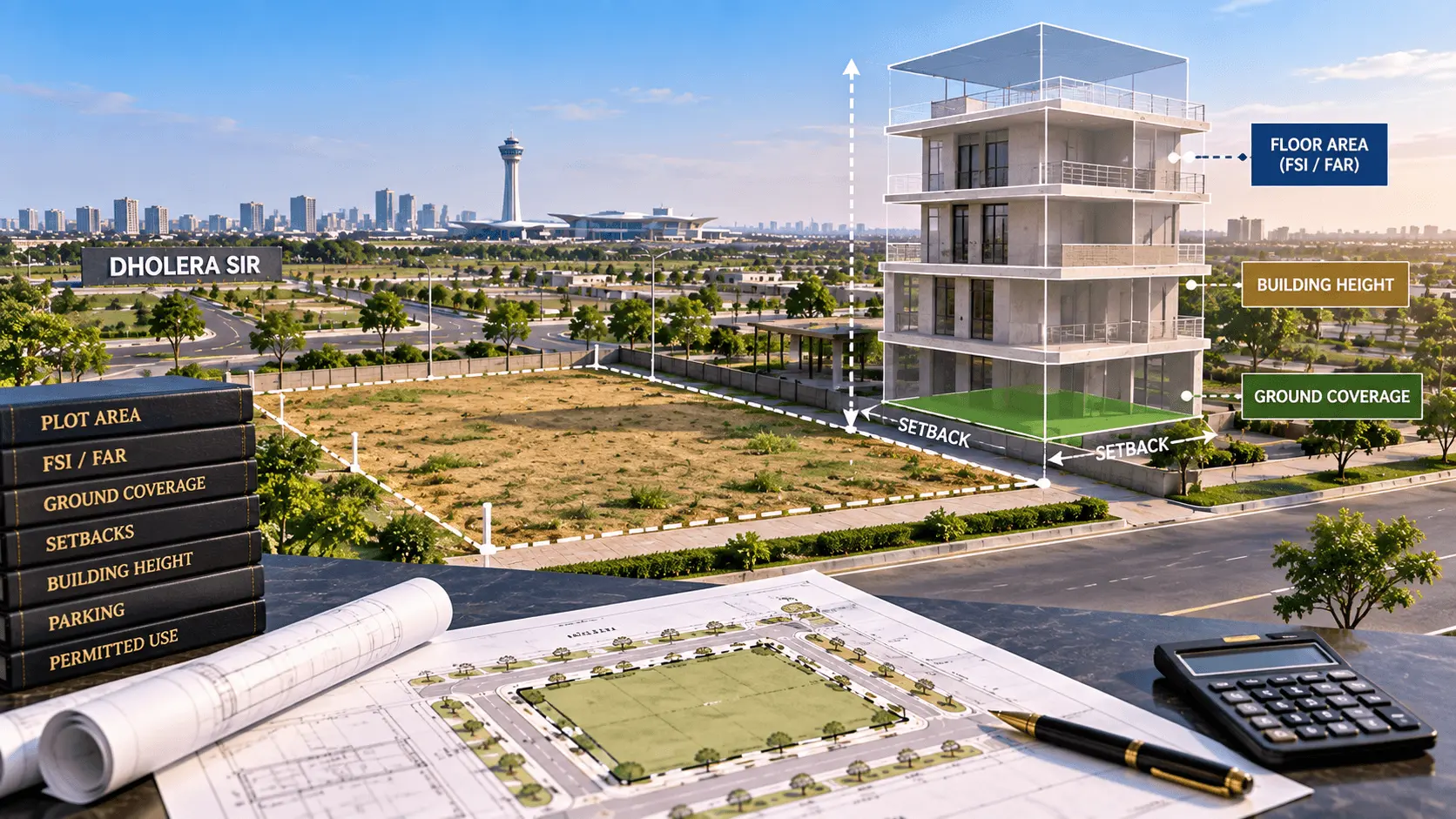
This is where terms such as FSI, FAR, setbacks, ground coverage and building height become relevant.
For buyers considering land in Dholera, these terms matter because the value of a plot for future
construction depends on more than its size. Two plots with the same area can have different
development potential if their planning context, permitted use, dimensions or applicable development
controls are different.
Dholera SIR has a formal planning framework involving a sanctioned Development Plan, Town Planning
Schemes and development regulations. DSIRDA has responsibility for planning and development within
the Special Investment Region, while the Apex Authority approves Development Plans, Town Planning
Schemes and General Development Regulations.
That is why this article does not give one universal Dholera FSI or setback number.
Before using any such number for an actual plot, the current rule applicable to that particular land
needs to be identified first.
What Is FSI or FAR?
In practical planning discussions, both terms describe the relationship between the floor area of a
building and the area of the plot or building unit.
A simple way to understand the calculation is:
FSI/FAR = Countable floor area ÷ Plot or building-unit area
Official Gujarat development-control regulations also use this basic ratio approach, while the detailed
rules determine which areas are counted or excluded from the calculation.
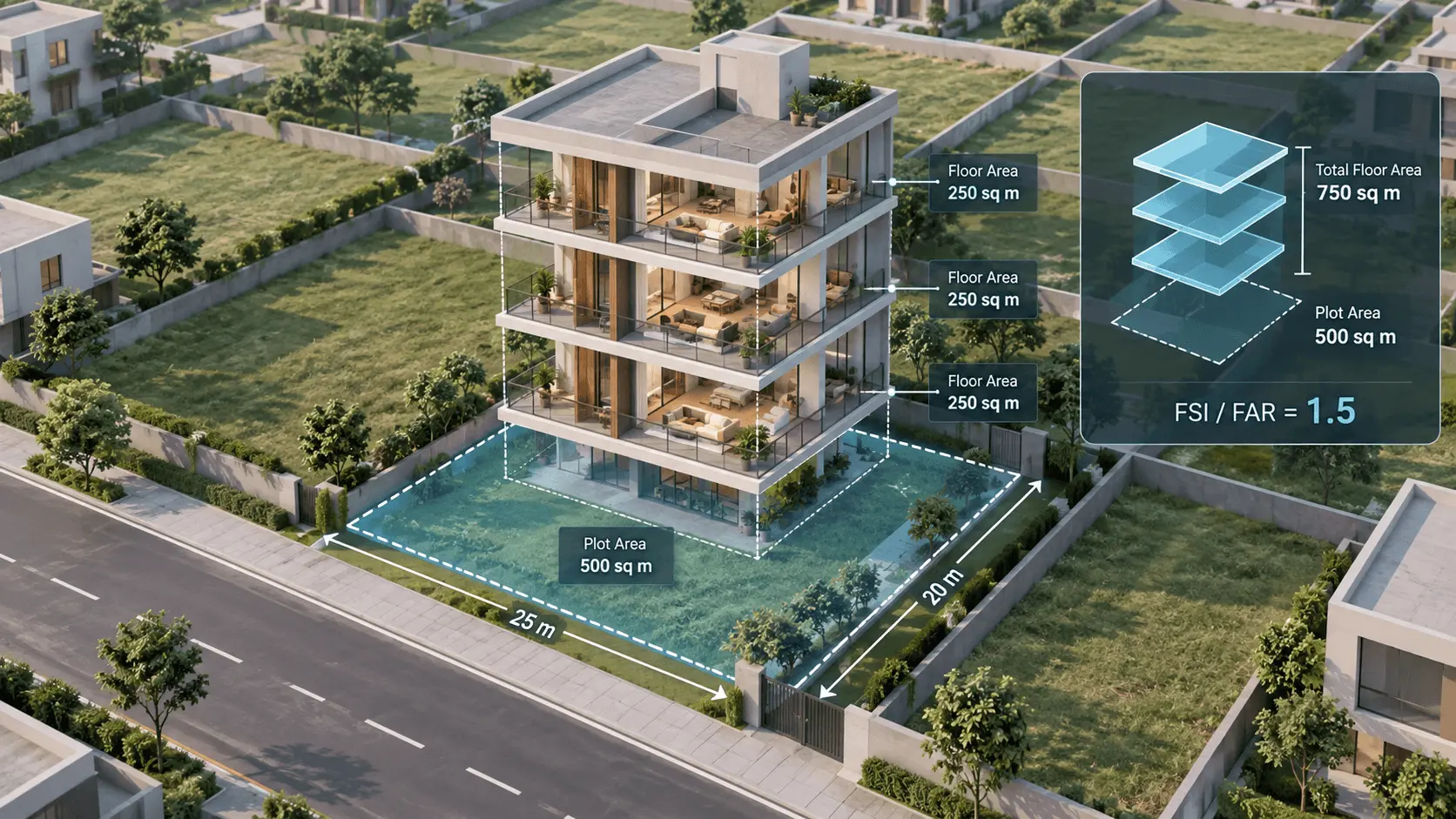
Consider a purely mathematical example.
Suppose a 500 sq. m. plot were subject to an FSI/FAR of 1.5.
The calculation would be:
500 sq. m. × 1.5 = 750 sq. m.
That would represent 750 sq. m. of FSI-counted floor area in this hypothetical example.
It does not mean that 750 sq. m. can be constructed on the ground floor.
It also does not mean that 1.5 is the applicable FSI for a Dholera plot. The example is only to explain
how the ratio works.
Plot Area and Construction Area Are Different Things
This distinction sounds simple, but it is often missed when land is marketed.
The plot area tells you how much land the plot contains.
FSI or FAR deals with the amount of floor area that may be counted across the building.
Ground coverage deals with how much of the plot can be occupied by the building footprint at ground
level.
Setbacks determine where the building can sit within the plot.
Height, parking, access, permitted use and other controls can further affect the final design.
So a buyer should not calculate construction potential by looking at plot area alone.
The real question is:
What type and amount of construction can be approved on this particular plot under the current
applicable regulations?
What Is a Setback?
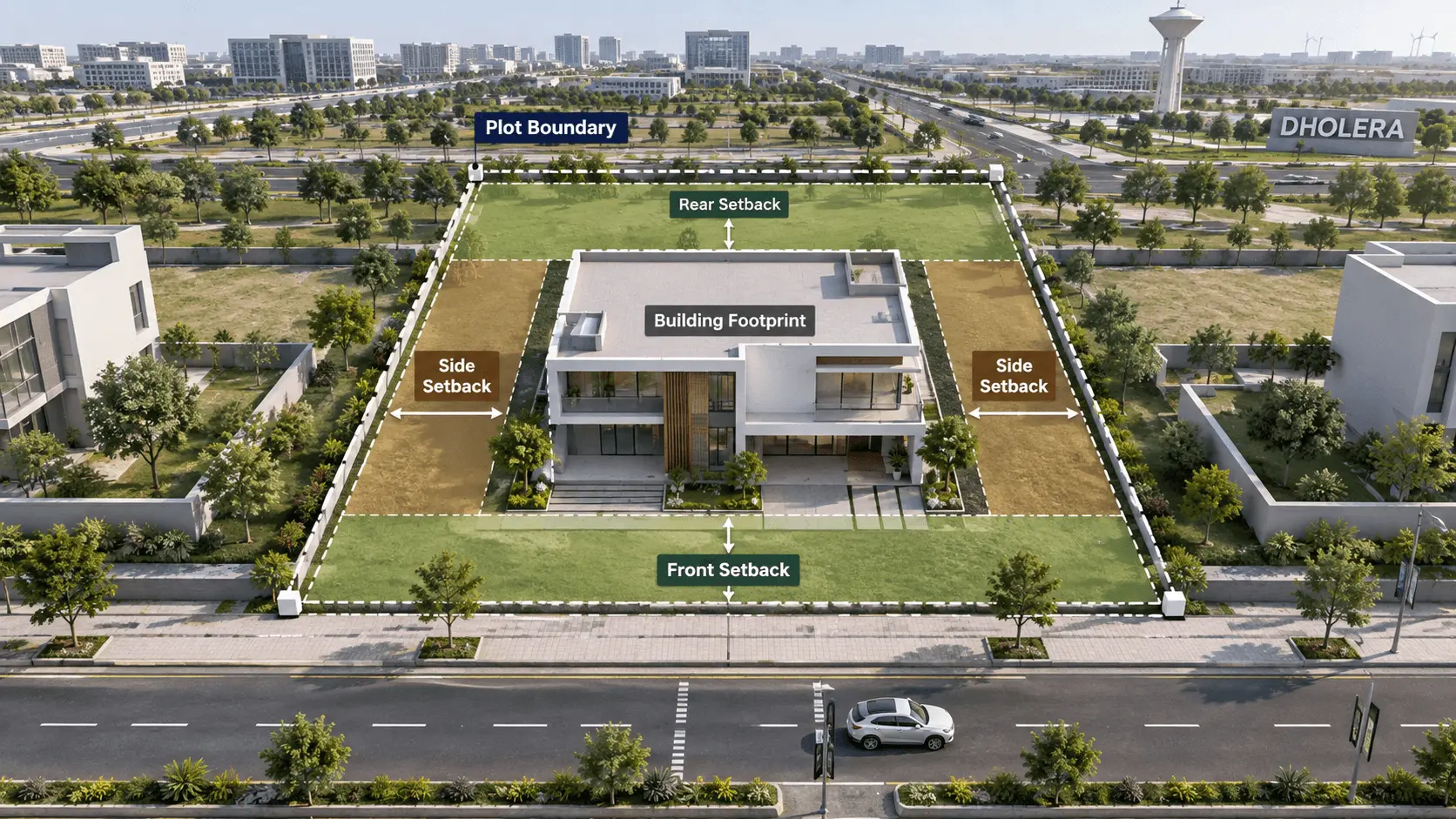
A setback is the required open distance between a building and a relevant plot boundary.
Depending on the applicable development rules, there may be requirements for the front, rear and
sides of a building.
You may also hear the word margin used for similar required open spaces in Gujarat development-
control terminology.
Imagine a rectangular plot on paper.
The plot boundary shows the land you own. A setback does not normally remove that land from your
ownership.
Instead, it affects where the main building can be positioned.
If a particular distance has to remain open along the front or sides, the building footprint has to fit
inside the remaining permissible area.
This is one reason why a plot can be legally large enough for a project but still have a smaller practical
building footprint.
Can I Construct on My Full Plot Area?
A buyer should not assume so.
Even if you own the complete plot, development controls may require open margins, regulate ground
coverage, restrict building height or impose other design requirements.
There may also be space needed for vehicle access, parking, services and other requirements
depending on the proposed use and building.
So these two statements are very different:
“I own a 400 sq. m. plot.”
and “I can construct over all 400 sq. m. on the ground.”
The first describes land ownership.
The second is a planning and building-permission question.
Before designing a house, commercial building or other structure, the second question needs to be
answered from the applicable regulations and approved plan.
Ground Coverage Is Not the Same as FSI
This is another common source of confusion.
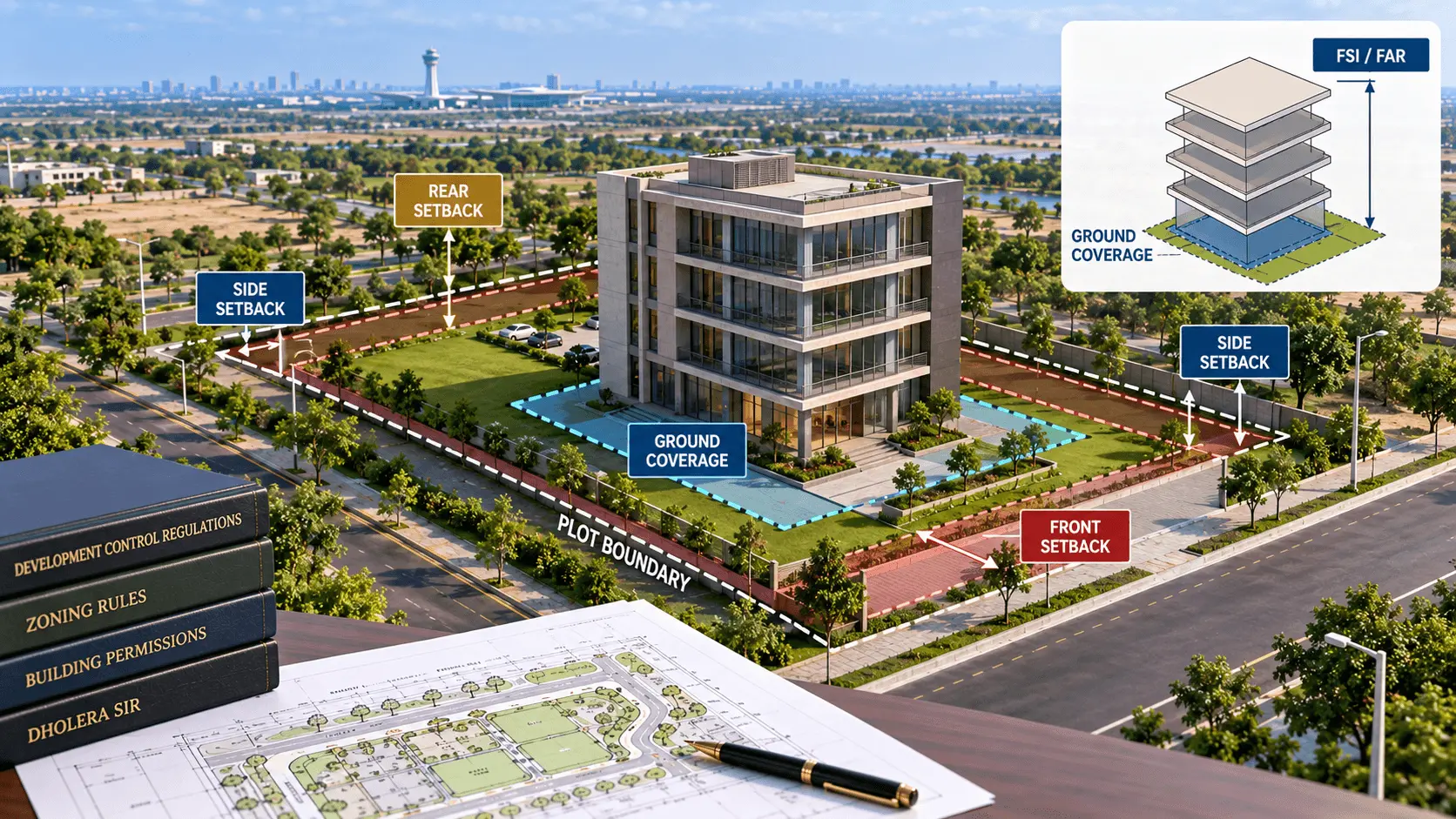
Ground coverage deals broadly with the portion of the plot occupied by the building footprint at ground
level.
FSI/FAR deals with floor area across the building.
Suppose, only as an illustration, that planning rules allowed a building to occupy part of the plot at
ground level while permitting additional construction on upper floors.
The building could therefore have a smaller ground footprint but a larger total floor area.
That is why knowing only the FSI does not tell you the final shape of the building.
You also need to understand the controls affecting:
The final construction potential comes from these rules working together.
Does the Same FSI Apply Everywhere in Dholera?
A single FSI figure should not be assumed for every property marketed as being in Dholera.
Dholera SIR is a planned region with a sanctioned Development Plan and multiple Town Planning
Schemes. Gujarat’s SIR framework also provides for Development Plans, Town Planning Schemes and
General Development Regulations to operate as part of the region’s planning system.
In practical terms, construction potential has to be checked against the planning position of the specific
land.
A plot’s applicable development controls can depend on matters such as its planning zone, permitted
use, building type, plot characteristics and the regulations currently applicable to the site.
For that reason, a statement such as:
“Dholera has X FSI everywhere”
should not be used as the basis for purchasing or designing a building unless the person giving that
number can show the current regulation and explain why it applies to that exact plot.
The same caution applies to setbacks.
There is no responsible way to publish one front, rear or side setback number and present it as the rule
for every Dholera property without first identifying the relevant planning category and current
regulation.
First Check Whether the Plot Is Actually Within Dholera SIR
This should happen before discussing Dholera plot FSI.
The term “Dholera” is used widely in property marketing, and a plot described as being near Dholera is
not necessarily governed by exactly the same planning framework as land situated within the notified
Dholera Special Investment Region.
DSIRDA’s planning responsibility relates to Dholera SIR. Official Gujarat information describes DSIRDA
as the Regional Development Authority responsible for planning and development of the region.
So the first step is to identify the actual land.
Check its location, survey or Final Plot details where applicable, Town Planning Scheme position and the
authority having planning jurisdiction over it.
Only then does it make sense to ask what FSI, FAR, setback or other development control applies.
Zone Comes Before FSI
A buyer may sometimes ask for the FSI before asking what use is permitted on the land.
That reverses the correct order.
First establish how the plot is designated under the applicable planning framework.
Then establish what type of development is permitted or conditionally permitted.
After that, the relevant development controls can be checked.
A residential use, commercial project, industrial building or another type of development should not
automatically be assumed to have identical construction controls.
The size of the plot alone cannot answer the use question either.
A large plot in the wrong planning category for the buyer’s intended project may be less useful than a
smaller plot that properly supports that use.
Road Access Can Matter to Construction Planning
Road access should also be checked before estimating Dholera buildable area.
The plot may have a road shown in a layout, a road in a Town Planning Scheme, an existing physical
approach or some combination of these.
Those are not always the same thing.
From a construction-planning perspective, an architect or planner will need to establish the applicable
access and road context before preparing a compliant proposal.
This is another reason why an online FSI calculator cannot provide a reliable final answer from plot area
alone.
What Does “Buildable Area” Actually Mean?
The phrase “buildable area” is commonly used, but it can mean different things in a sales conversation.
A seller may use it to mean permissible floor area.
An architect may be discussing the building footprint.
Someone else may mean the portion of the plot left after setbacks.
These are not automatically the same number.
For a buyer, it is better to separate the concepts.
Plot Area:
The area of the land parcel.
Building Footprint:
The portion of the plot occupied by the building at ground level.
FSI/FAR Floor Area:
Floor area calculated according to the applicable FSI/FAR provisions.
Buildable Envelope:
The practical area and volume within which a building may be designed after considering setbacks,
height and other controls.
Usable Internal Area:
The space actually available inside the finished building after considering walls, circulation, services and
other components.
This is why a promise such as “you can build 2,000 sq. ft.” needs more context.
The buyer should ask what that figure represents and which current regulation was used to calculate it.
Is Higher FSI Always Better?
Not necessarily.
Higher permissible FSI can increase potential floor area, but development feasibility involves more than
maximum floor space.
A particular project still has to work with plot dimensions, access, parking, setbacks, building height,
services, construction cost and the intended use.
A buyer planning a private residence may assess a plot very differently from someone considering a
commercial or larger development.
The useful question is therefore not:
“Which plot has the highest FSI?”
It is:
“Which plot supports the type of building I actually want to develop?”
Why Maximum FSI and Practical Construction May Differ
Even after the applicable FSI is identified, you should not assume that every last square metre of
theoretical floor area can automatically be used in the design you have in mind.
Other development controls still have to be satisfied.
Setbacks may limit the floor plate.
Height controls may affect how floor area can be distributed vertically.
Parking and access requirements may consume part of the site or building.
The permitted use can affect the type of building that may be proposed.
Building design also has to comply with the applicable approval and safety requirements.
In other words, permissible FSI is a development limit, not a finished architectural plan.
An architect still has to demonstrate how the proposed construction fits legally and physically on the
site.
Town Planning Scheme Records Also Matter
Dholera’s development is being implemented through Town Planning Schemes.
Official records describe the urban development area as divided into six Town Planning Schemes, with
planning and infrastructure provision being carried out through that mechanism.
This matters because buyers may come across Survey Numbers, Original Plot Numbers and Final Plot
Numbers when checking land in Dholera.
Before preparing a building plan, the plot used for construction planning should be identified correctly
in the applicable planning records.
A buyer should avoid estimating FSI or setbacks against an informal sales drawing if the legal and
planning identity of the plot has not yet been confirmed.
For more background on these terms, read:
Dholera TP Scheme, Survey Number & Final Plot Explained
Buying a Plot Today for Construction Years Later
Some Dholera buyers purchase land with no immediate intention to build.
They may plan construction five, ten or more years later.
In that situation, today’s development control can still help the buyer understand the current planning
position, but it should not be treated as a permanent guarantee of what will be allowed many years in
the future.
Planning regulations can be amended.
Development plans can be modified through the applicable legal process.
Infrastructure and surrounding development can also change.
So if construction is planned for the future, the applicable rules should be checked again when an
actual building proposal is prepared.
A statement about today’s FSI should not be converted into a promise about a building permission that
may be sought years later.
What Should a Buyer Check Before Planning Construction?
Before relying on any Dholera FAR, setback or construction-area figure, identify the property properly.
The check should normally answer these questions:
Once these questions have been answered, an architect or qualified planning professional can prepare
a much more realistic estimate of construction potential.
Starting with “I have a 500 sq. m. plot, how much can I build?” skips too many steps.
Frequently Asked Questions
Conclusion
Plot size is useful information, but it does not tell a Dholera buyer the complete construction story.
FSI or FAR affects how much floor area may be permitted. Setbacks influence where the building can sit.
Ground coverage affects the footprint, while height, access, parking, plot dimensions, permitted use
and other development requirements can shape the final proposal.
Dholera SIR also has a formal planning structure built around its Development Plan, Town Planning
Schemes and development regulations. That means construction potential should be checked against
the actual planning position of the land rather than a single FSI or setback number being applied across
the entire region. Official Gujarat records confirm DSIRDA’s planning role and the Apex Authority’s role
in approving the region’s Development Plan, Town Planning Schemes and General Development
Regulations.
For someone buying a plot with future construction in mind, the best time to ask these questions is
before the purchase.
Confirm the plot, its planning jurisdiction, applicable zone and intended use. Then have the current FSI/
FAR, setbacks and other development controls checked against the rule that actually applies to that
land.
A larger plot may offer more land.
It does not automatically offer proportionately more construction.
Disclaimer
This article is published by
Dholera City Buildconz for general educational and informational purposes.
It is intended to explain basic concepts such as FSI/FAR, setbacks, ground coverage and construction
potential in the context of property research in Dholera.
Dholera City Buildconz is an independent real estate company. It is not a government
department, government company, statutory authority or government agency. The company is
not part of, owned by, operated by or acting on behalf of DICDL, DSIRDA, GIDB,
NICDC, the
Government of Gujarat, the Government of India or any other government authority.
References to Dholera SIR, DICDL, DSIRDA,
GIDB, Town Planning Schemes, government planning
documents or other official bodies are included only to explain the planning context. They do not imply
any government partnership, appointment, authorisation, affiliation, approval or endorsement of
Dholera City Buildconz.
No universal FSI, FAR, setback, ground-coverage or construction figure is being represented in this
article as applicable to every plot in Dholera. The permissible development of a specific property can
depend on its exact location, planning jurisdiction, zone, land use, plot dimensions, applicable Town
Planning Scheme, proposed building use and the development regulations in force when permission is
sought.
Planning rules and development regulations may also be amended over time. A construction estimate
prepared today should therefore not be treated as a guarantee of permission for a building proposal
submitted in the future.
Before purchasing land for construction or preparing a building plan, buyers should verify the specific
property against the current records and regulations of the competent authority and obtain plot-
specific advice from a qualified architect, engineer, planner or legal professional where appropriate.