Introduction
A plot may have clear documents,
suitable zoning and enough permissible construction potential, but those checks do not tell an engineer what is below the ground. Before foundation design, the structure and behaviour of the soil still need to be understood for the specific site.
This is the purpose of Dholera plot soil testing. A geotechnical investigation helps the design team understand the soil and rock layers below the plot, engineering properties that may affect the foundation, groundwater conditions observed during investigation and other site factors relevant to construction.
The Bureau of Indian Standards currently lists
IS 1892:2021 as the Code of Practice for Subsurface Investigation for Foundations. The standard’s investigation framework covers the sequence and extent of soil and rock strata, their engineering properties and groundwater conditions that may affect foundation design and construction.
This does not mean every
Dholera plot needs the same number of boreholes, the same test programme or the same foundation. Soil conditions can change across a site, and the building itself also matters. A small low-rise structure and a much heavier building can create very different engineering requirements on the same land.
For that reason, soil testing should be treated as a site-specific engineering exercise, not as a standard certificate attached to the location name “Dholera.”
What Does Dholera Plot Soil Testing Reveal?
A Dholera geotechnical investigation should do more than provide one bearing-capacity number at the end of a report.
The investigation normally builds a picture of what lies below the proposed structure. This can include the sequence of soil layers, depth and condition of different materials, field-test observations, samples collected for laboratory testing and groundwater encountered during the investigation.
BIS’s subsurface-investigation framework specifically recognises soil and rock strata, engineering properties and groundwater as factors that may affect the design and method of construction.
For a buyer or developer, the report can help answer practical questions such as:
The report does not replace structural design. It supplies engineering information that the structural and foundation designers use in deciding how the proposed building should transfer its loads safely into the ground.
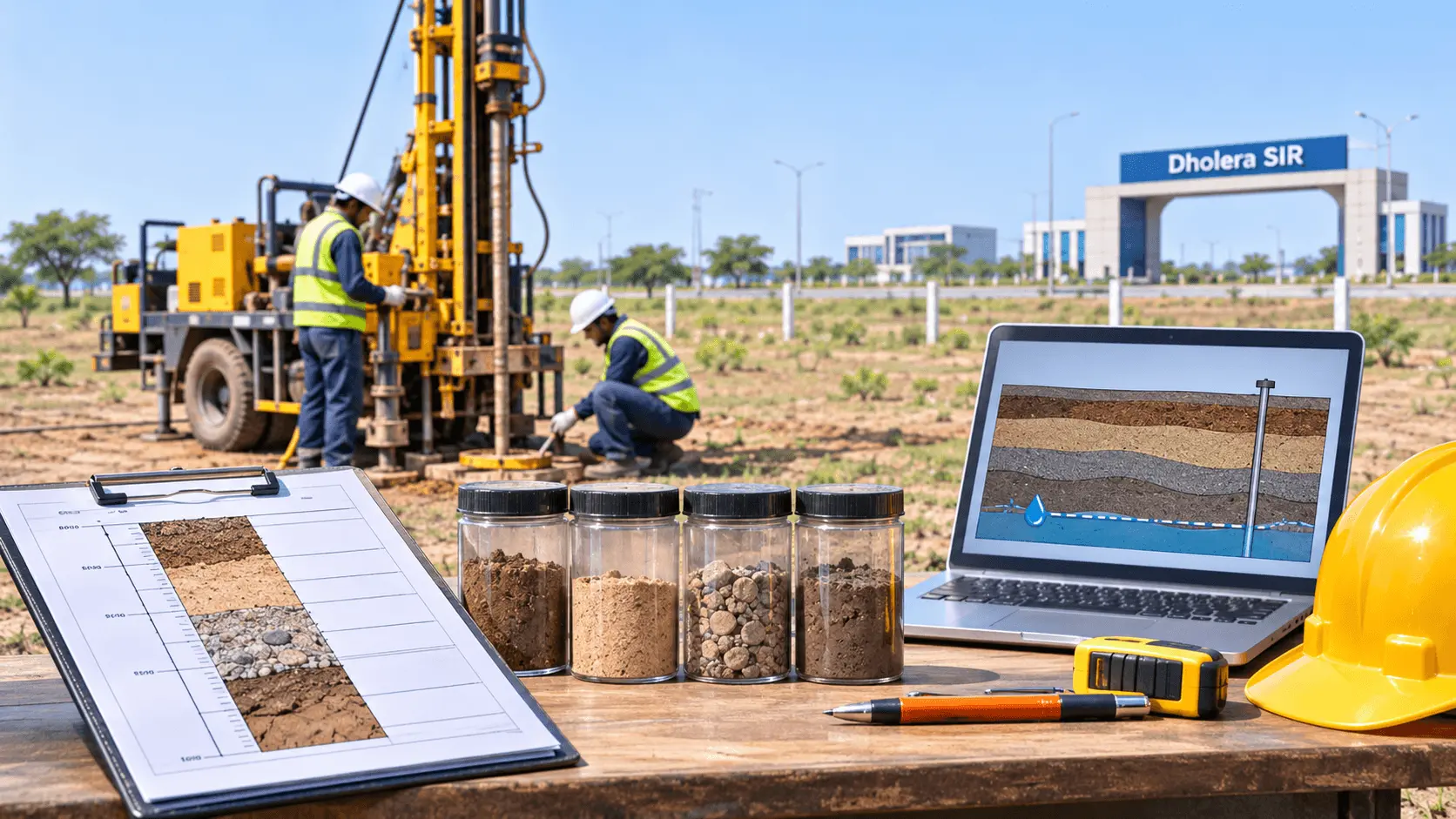
Soil Bearing Capacity Is Important, but It Is Not the Whole Report
Buyers often ask one question first:
“What is the SBC of this plot?”
Soil bearing capacity is important, particularly when shallow foundations are being considered, but reducing an entire geotechnical investigation to one SBC number can be misleading.
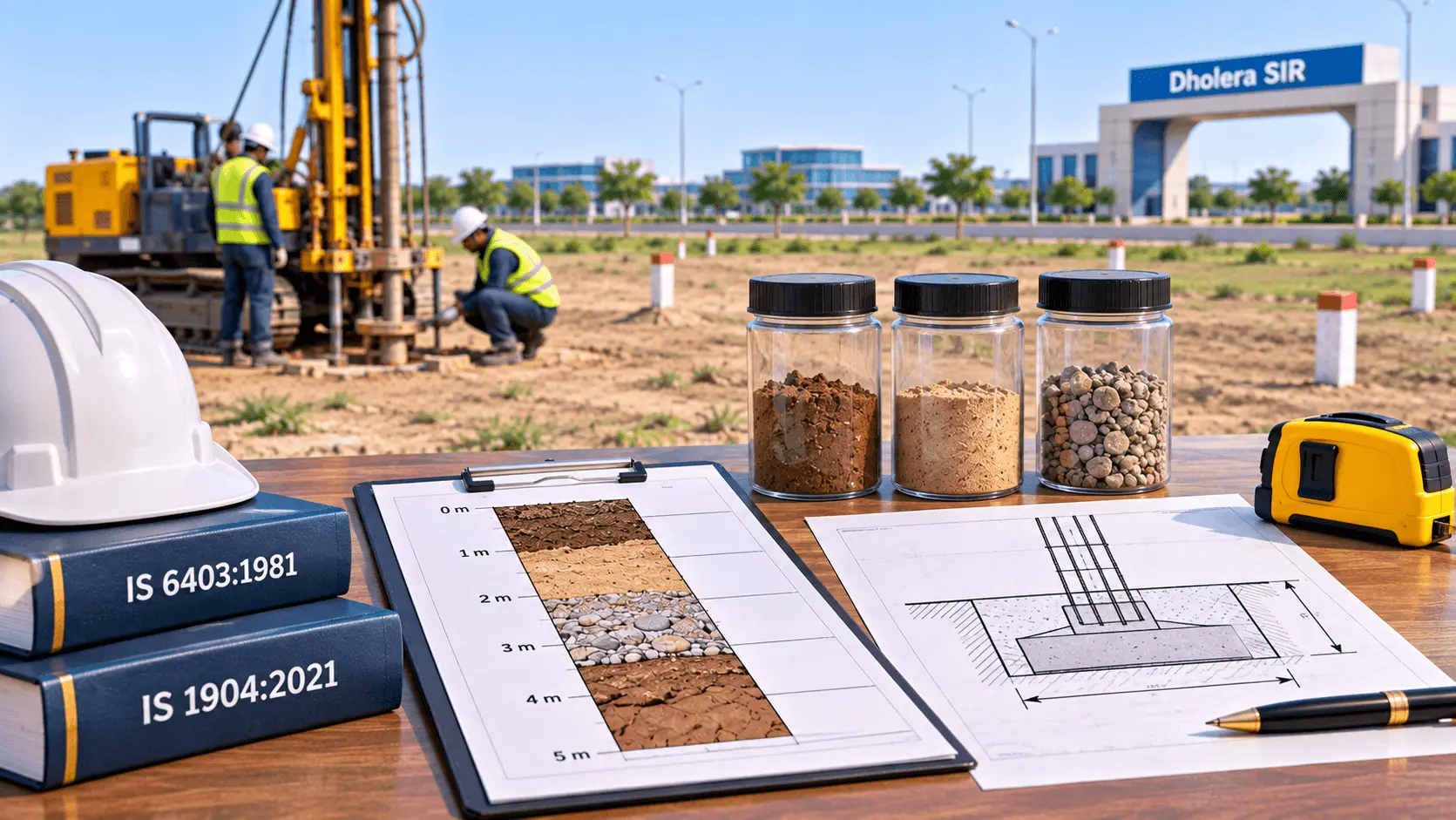
BIS currently lists IS
6403:1981 as the Code of Practice for Determination of Bearing Capacity of Shallow Foundations. BIS also lists IS
1904:2021 for the general requirements for design and construction of foundations in soils.
The foundation engineer also has to consider settlement and the characteristics of the soil profile. A foundation can face design limitations even where a simple bearing-capacity calculation appears acceptable.
The proposed footing dimensions, depth, structural loads, groundwater conditions and soil parameters can all affect the engineering decision. That is why a number copied from a neighbouring project should not be treated as the soil bearing capacity of your plot.
A site investigation should support the actual building being proposed.
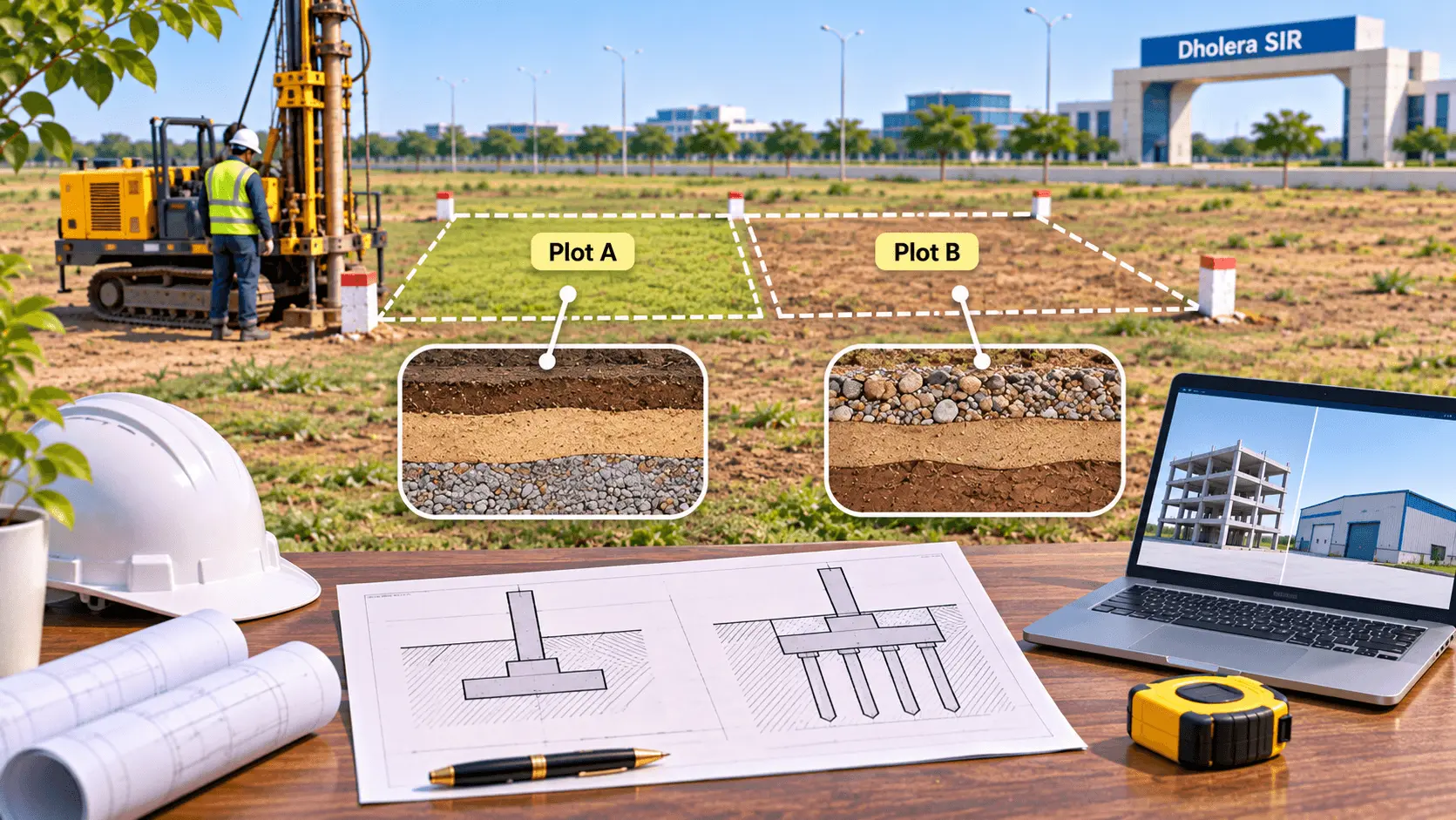
Why Two Nearby Dholera Plots Can Need Different Foundation Designs
Two nearby plots do not automatically have identical subsurface conditions.
One plot may contain natural soil close to ground level while another may contain placed fill. The thickness of individual layers can vary, groundwater observations can differ and field-test resistance can change over relatively short distances.
The buildings may also be different.
A lightweight structure, a multi-storey building, an industrial building and a structure carrying concentrated equipment loads do not impose the same foundation demands.
Foundation feasibility therefore depends on two sets of information working together:
Ground conditions: what the geotechnical investigation finds.
Structural requirements: what the proposed building will place on that ground.
This is why a soil report prepared for Plot A should not automatically be copied for Plot B merely because the plots are in the same village, TP Scheme or project.
Nearby information may help an engineer understand the broader context, but it does not replace site-specific investigation where the proposed construction requires one.
What Happens During Soil Investigation?
The investigation programme should be selected by the qualified geotechnical engineer for the site and proposed project.
Depending on the requirement, work may involve boreholes, sampling, field tests and laboratory tests. The purpose is to obtain enough reliable information to develop an engineering model of the ground beneath the proposed construction.
One commonly used field test is the Standard Penetration Test, or SPT. BIS currently lists IS 2131:2025 as the Standard Penetration Test of Soil – Method of Test.
An SPT result should not be read in isolation by a buyer. The engineer interprets it together with the soil description, depth, sampling information and other investigation findings.
Laboratory testing may also examine relevant soil characteristics depending on the material encountered and design requirement. BIS maintains the IS 2720 series covering different methods of testing soils, including properties relevant to soil classification and engineering behaviour.
The actual test schedule should come from the engineer rather than a fixed online checklist.
A Sample Geotechnical Report : How a Buyer Should Read It
Consider a purely hypothetical example prepared for buyer education.
A proposed building plot is investigated before structural design. The report does not belong to an actual Dholera parcel and the observations below should not be treated as typical Dholera soil conditions.
The investigation finds that the near-surface material differs from the layers encountered further below. Field resistance varies with depth, groundwater is observed during the investigation and laboratory testing identifies engineering characteristics that need to be considered in foundation design.
A buyer should not look at this information and personally decide:
“This means I need a pile foundation.”
That is the engineer’s decision.
Instead, the buyer should understand what questions the findings create.
If weak or variable material is present near the surface, the engineer may need to consider its effect on foundation behaviour.
If stronger material is encountered deeper down, its relevance depends on the proposed loads and the type of foundation being evaluated.
If groundwater is observed, excavation, construction procedure, temporary works and foundation design may require additional consideration.
If the laboratory results indicate soil behaviour that could affect settlement or volume change, the design team should address that in its recommendations.
The report should therefore connect observations → engineering interpretation → design parameters or recommendations.
A table containing test results without engineering interpretation is much less useful to a buyer.
Why Groundwater Matters
Groundwater is not simply a question of whether the plot feels wet when someone visits it.
BIS’s subsurface-investigation framework specifically includes the location of groundwater among the matters relevant to foundation investigation. It also recognises possible effects of soil and water on foundation materials.
Groundwater can affect excavation and temporary construction conditions. It can also influence how engineers evaluate soil behaviour and foundation work.
However, one groundwater observation should not automatically be treated as a permanent fixed water level.
Groundwater conditions can vary with time, season, drainage, nearby development and other site factors. A geotechnical report should state what was actually observed and when, while the engineer decides how those observations need to be treated in design.
For foundation feasibility in Dholera, buyers should therefore ask whether groundwater was investigated and how the report accounts for it, rather than asking for one universal groundwater depth for the entire area.
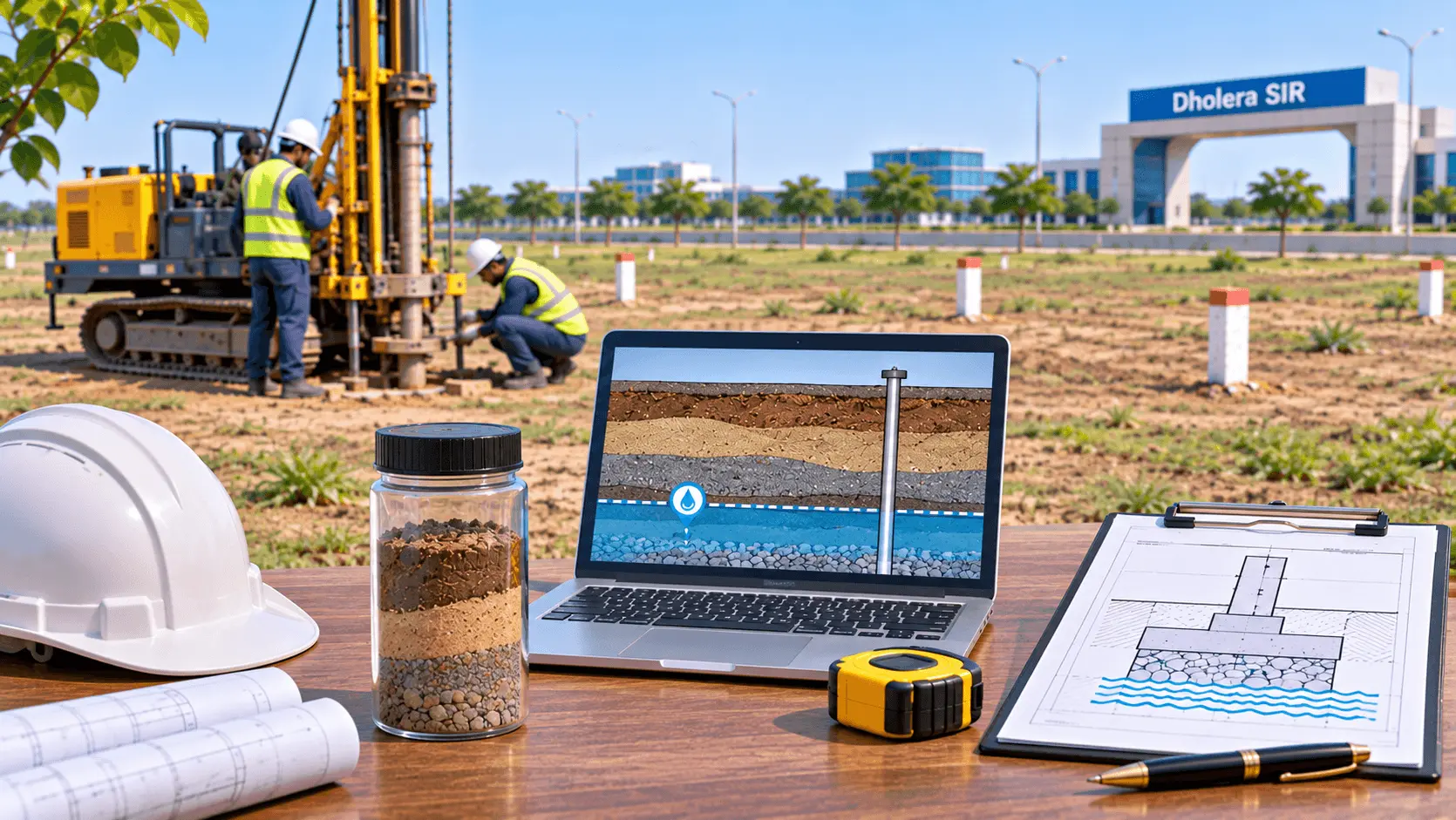
What Should the Report Say About Soil Layers?
A useful report should make the subsurface profile understandable.
Borehole or investigation logs normally help show how the material changes with depth. The engineer can then correlate field observations, samples and test results with those layers.
The buyer does not need to become a soil engineer, but the report should allow the design team to answer:
The investigation depth itself should not be selected from a generic internet recommendation.
The required exploration depends on the proposed structure, foundation influence zone, site conditions and professional judgement. This is one reason this article does not recommend a universal borehole depth for Dholera plots.
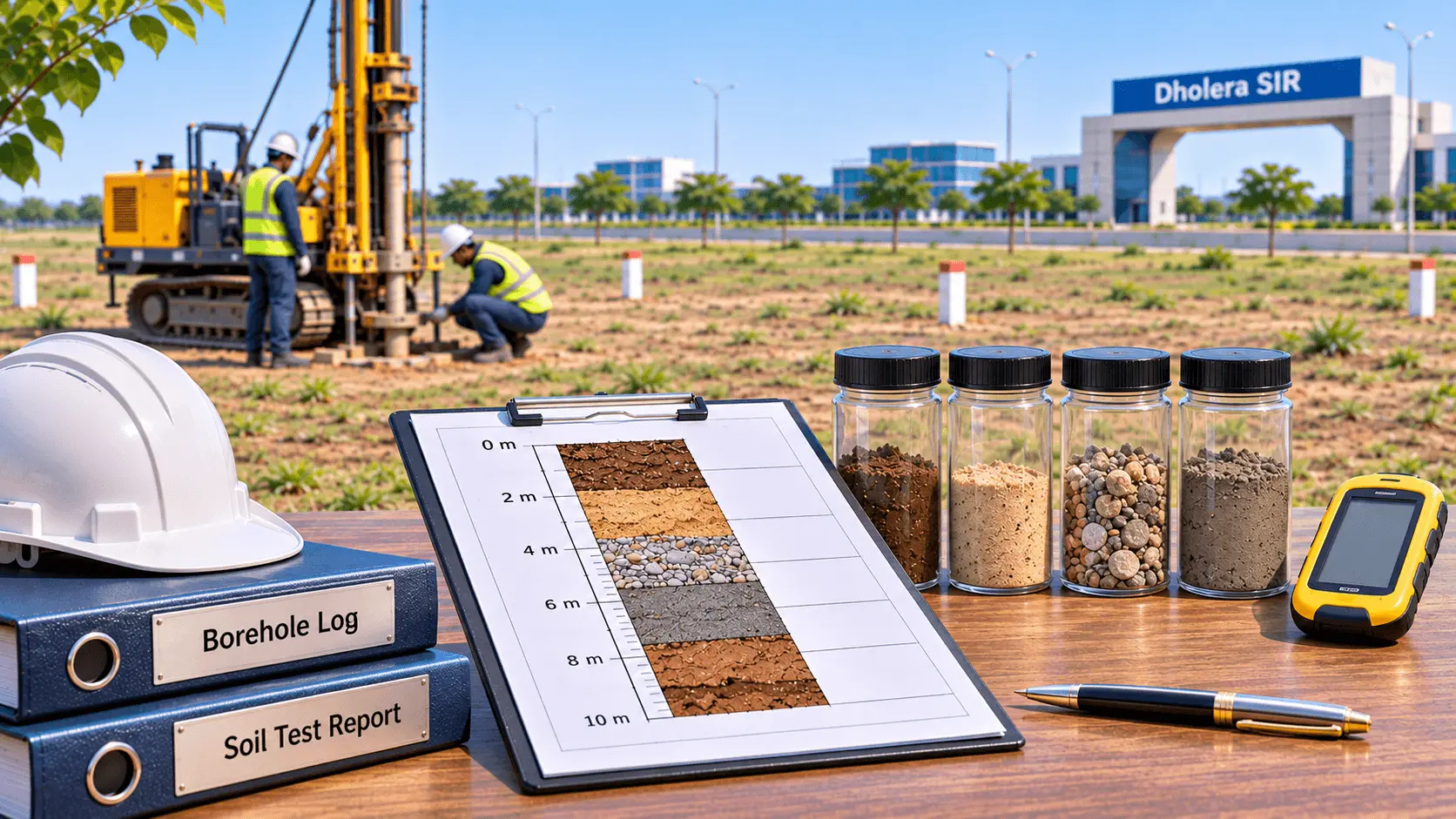
How Dholera Plot Soil Testing Affects Foundation Design
After investigation, the geotechnical engineer interprets the data and develops parameters and recommendations for the design team.
That does not mean the geotechnical report independently completes the foundation design. Foundation selection normally needs coordination between geotechnical information and the structural loads.
BIS’s current IS 1904:2021 provides general requirements for design and construction of foundations in soils and itself references subsurface investigation and different foundation-related standards.
Depending on the project-specific findings, the engineering team may evaluate shallow foundations, raft-type solutions, deeper foundations, ground improvement or other approaches.
The presence of those options in engineering practice should not be turned into a recommendation for an untested plot.
A buyer’s takeaway should be simpler:
Soil report first, structural loads next, foundation design after engineering review.
How Dholera Plot Soil Testing Affects Construction Costs
This is where geotechnical investigation becomes relevant even for buyers who are not engineers.
A preliminary building estimate may assume straightforward excavation and foundation work. If later investigation identifies additional engineering requirements, the cost can change.
Potential cost drivers can include:
None of these costs should be assumed before the report is reviewed.
The purpose of Dholera plot soil testing is not to make every project more expensive. It is to identify relevant ground conditions early enough for the engineer and estimator to price the proposed design more realistically.
Spending on an investigation can therefore provide information before the buyer accepts a foundation estimate based mainly on assumptions.
What Should Be Checked Before Accepting a Construction Estimate?
If a contractor gives a construction quotation before the soil report has been reviewed, ask what foundation assumptions were used.
A useful pre-estimate discussion should identify:
This is especially important when two quotations differ substantially.
The cheaper estimate may simply be based on a different foundation assumption.
Before comparing total prices, compare the engineering scope.
Do Not Copy a Neighbour's Soil Report
A neighbouring report can be informative, particularly during early feasibility discussions, but it should not automatically become the design report for another parcel.
The subsurface profile can vary, and building loads can vary even when ground conditions appear similar.
The better approach is to give any nearby investigation information to the appointed geotechnical engineer. The engineer can decide whether it is useful background information and what investigation is still required for the actual site.
This protects buyers from two opposite mistakes:
Over-testing without engineering reason, and
Under-investigating because a nearby project looked similar.
The investigation scope should be proportionate to the actual construction proposal.
Frequently Asked Questions
Conclusion
Dholera plot soil testing is not about obtaining one certificate or one SBC number before construction. It is about understanding the actual ground beneath the specific proposed building.
The current BIS framework for subsurface investigation looks at soil and rock strata, engineering properties and groundwater because all of these can influence foundation design and construction. BIS also maintains separate standards for general foundation requirements, shallow-foundation bearing capacity and field testing such as SPT.
For buyers, the report becomes most useful when it is reviewed before a foundation cost is treated as final.
A nearby plot’s report, an online SBC table or a contractor’s standard foundation depth cannot replace site-specific professional judgement.
The safer sequence is:
identify the correct site → investigate the ground → interpret the findings → coordinate with structural design → then finalise the foundation estimate.
That approach avoids both unnecessary assumptions and false certainty about Dholera ground conditions.
Disclaimera
This article is for general buyer education only. It is not a geotechnical investigation report, structural design, foundation recommendation or construction specification.
Ground conditions can vary from plot to plot. No statement in this article should be interpreted as saying that all Dholera land has a particular soil type, bearing capacity, groundwater level or suitable foundation system.
The number and depth of investigations, field and laboratory tests, design parameters, allowable pressures, settlement criteria and foundation solution should be determined for the specific site and proposed structure by appropriately qualified geotechnical and structural professionals using applicable current standards.
A geotechnical investigation does not establish title, property boundaries, zoning, NA status, development permission or FSI entitlement. Those matters require separate verification.
Dholera City Buildconz is an independent real estate consultancy/developer and is not affiliated with the Bureau of Indian Standards or any Government authority.