Introduction
Completing a registered sale deed is an important stage in a land purchase, but buyers should not treat
registration as the last records step. For rural revenue land, the transaction also needs to be reflected
through the mutation process so that the relevant Record of Rights is updated through Gujarat’s
revenue-record system.
This is where Dholera land mutation after registration becomes important. The purpose of mutation
is to record the change in rights arising from the transaction in the revenue records; it should not be
confused with a fresh sale deed or an independent legal opinion on title.
Gujarat’s e-Dhara system was created to computerise and update village land records through e-Dhara
Kendras at Taluka Mamlatdar offices. Government information also confirms that registration has been
integrated with e-Dhara so that successful agricultural land registrations can initiate auto-mutation and
notice generation.
For a Dholera buyer, the practical follow-up is therefore straightforward in principle: retain the
registration references, identify the mutation entry, follow its status and finally check whether the
relevant revenue records reflect the registered transaction correctly.
What Is Mutation After a Registered Sale Deed?
Mutation is the process by which a change affecting rights in land is entered into the revenue record.
A sale deed may create the transaction through registration, while the mutation process updates the
village revenue records to reflect that transaction. In Gujarat’s rural land-record system, mutation work
is handled through the e-Dhara workflow and the relevant revenue authorities.
The Government’s e-Dhara description states that e-Dhara Kendras operate at Taluka Mamlatdar offices
for day-to-day activities including mutations and issue of Record of Rights. The system also maintains
mutation applications, entry status and related land-record information electronically.
This distinction matters because buyers sometimes assume that once the registered document is
available, the buyer’s name must immediately appear on the 7/12 record. In practice, registration and
mutation are linked processes, but the mutation entry still goes through the statutory revenue-record
procedure.
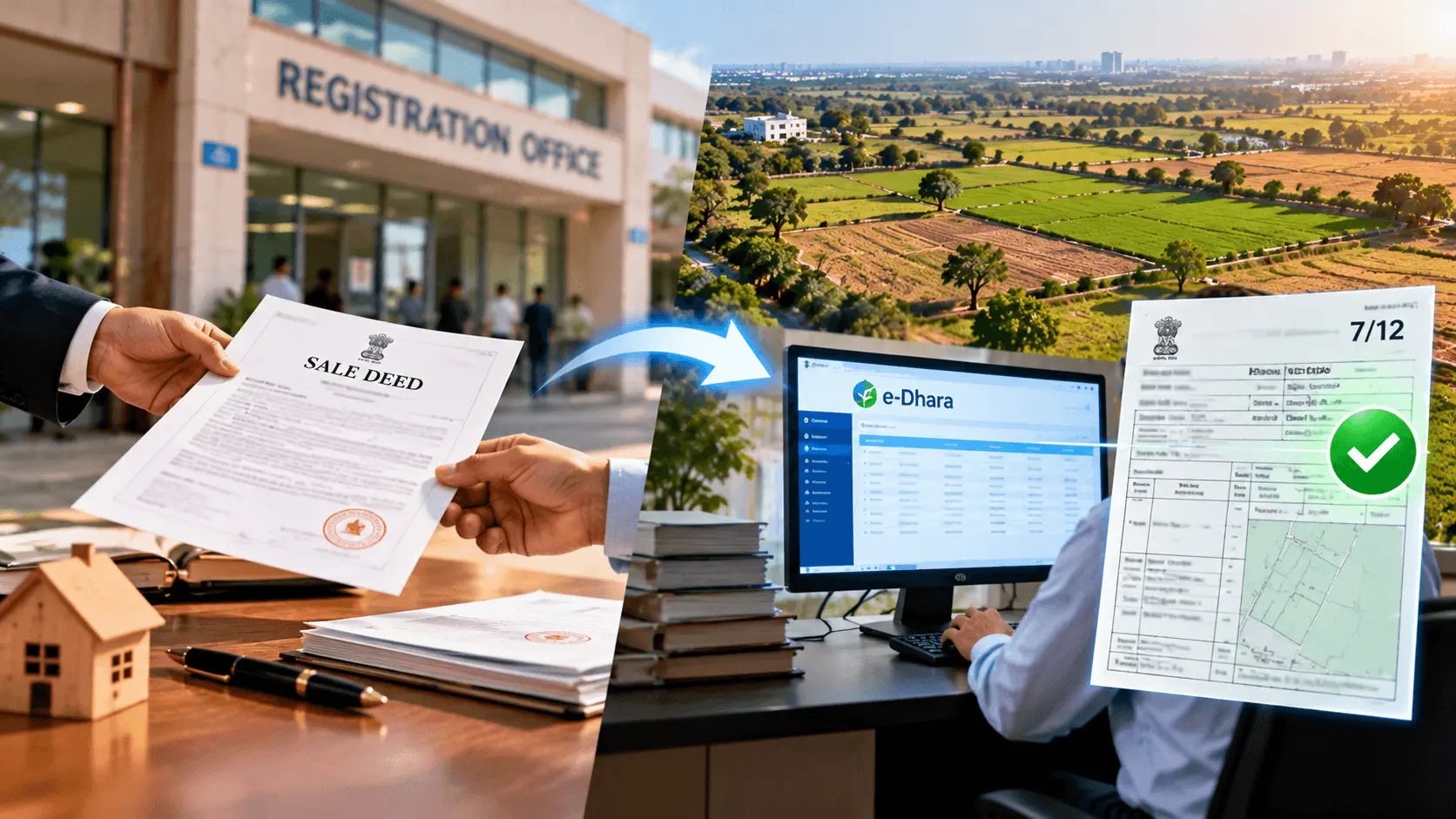
What Happens After Registration of Agricultural Land?
For registered agricultural land transactions, Gujarat has integrated the registration system with e-
Dhara.
According to the
Government’s e-Dhara project information, successful agricultural land registration is
linked with the land-record system for auto mutation and notice generation. This means the buyer
should normally first verify that the transaction has generated the corresponding mutation process
rather than automatically filing a duplicate request without checking the existing entry.
Government revenue guidance also explains why registered documents are treated differently from
some other acquisitions of rights. Where a transaction is made through a registered document, the
registration information is transmitted for revenue-record action and mutation is made on that basis.
This article therefore focuses primarily on rural revenue land where the e-Dhara/Record of Rights
system applies.
If a Dholera property is maintained under a property-card, city-survey or another record system rather
than the rural RoR system, the buyer should first identify the correct record authority instead of
assuming that the agricultural e-Dhara workflow applies unchanged.
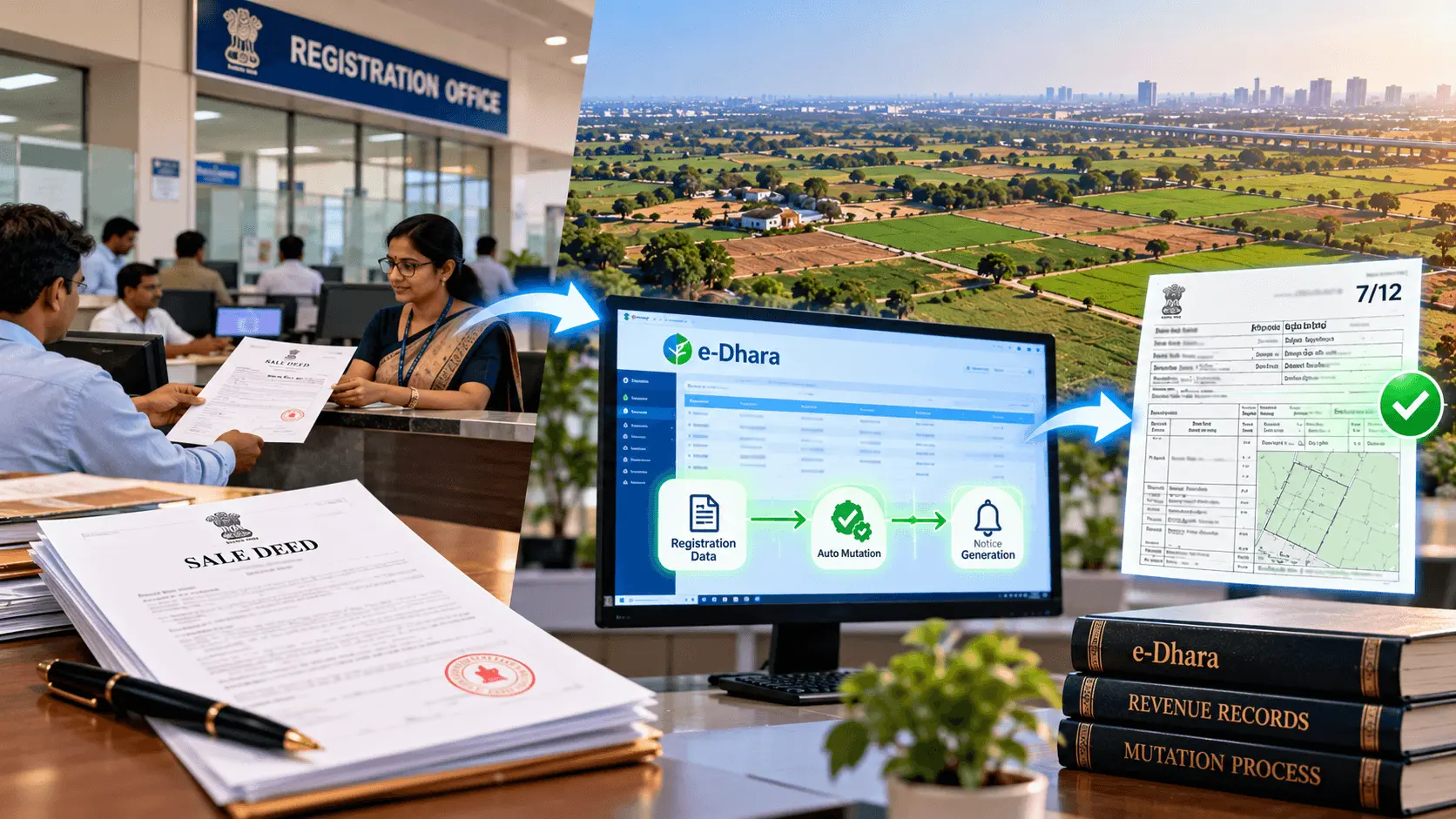
What Is the Next Records Step After Registration?
After registration, the buyer should first keep the registered-document details safely and confirm that a
mutation entry has been initiated against the correct land.
The important identifiers should match the transaction documents: village, survey or block number,
area, seller and buyer details and the registered document reference.
In the e-Dhara workflow, mutation applications are given a unique number. The Government Collector
Manual explains that the system generates a receipt carrying a unique number, and that the same
number is used in the mutation file and supporting case papers.
For an auto-mutation arising from a registered transaction, the buyer should therefore identify the
mutation-entry or case reference generated for that transaction and keep it together with the
registered deed documents.
The aim is simple: months later, nobody should have to search for the case only by the buyer’s name or
an informal plot description.
Which Documents and References Should the Buyer Retain?
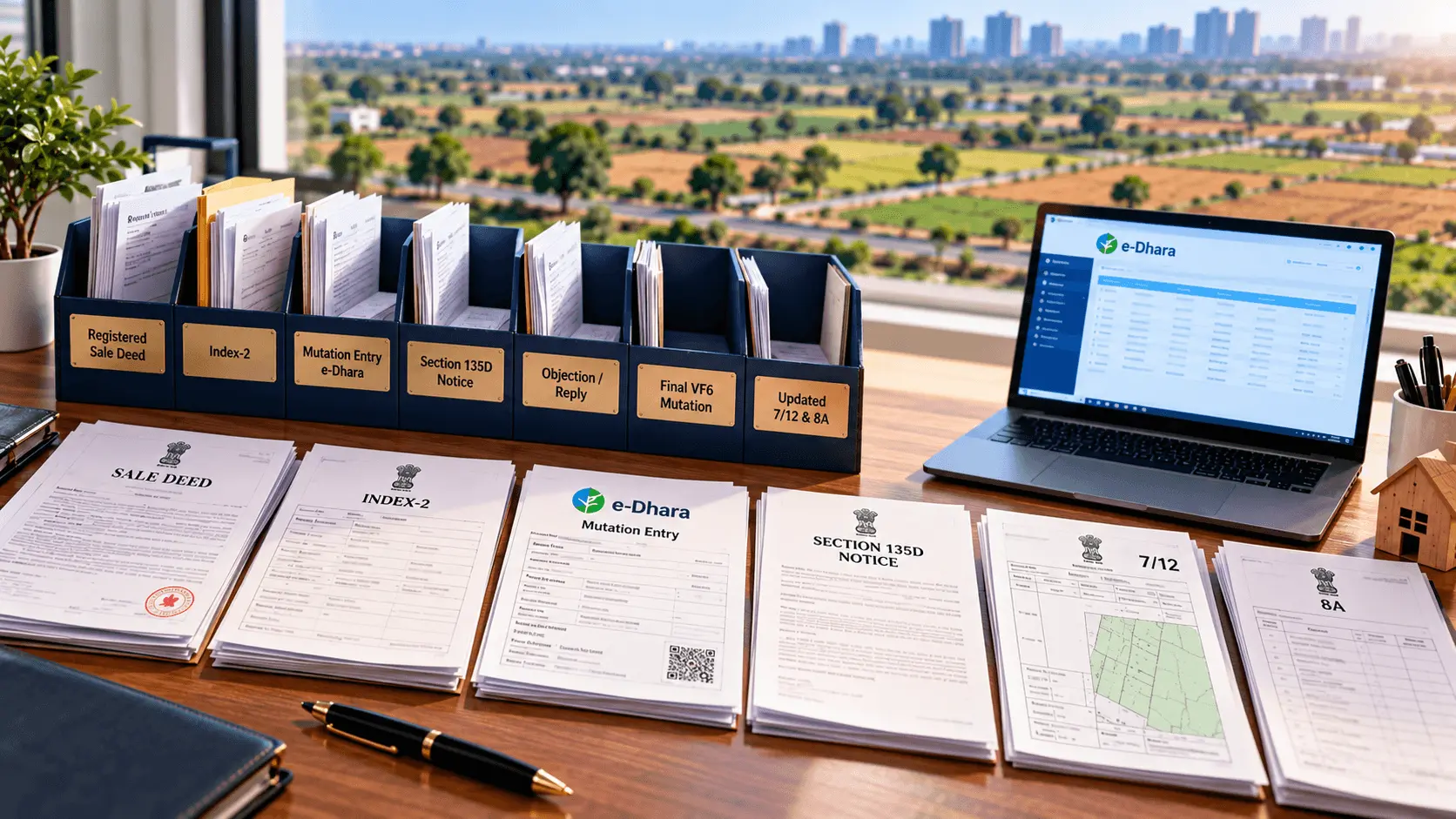
A good post-registration file should contain more than one document.
At minimum, the buyer should preserve the registered sale deed or its official copy, registration/
document number and any Index-2 or registration acknowledgement available through the
Government registration system.
For the mutation stage, also preserve the mutation entry number or unique e-Dhara reference
connected with the transaction. If a separate mutation request is made and a receipt is issued, the
Government procedure provides for a generated receipt with a unique number.
Where a Section 135D notice is received, keep that as well. If any written objection is filed, the
acknowledgement of that objection becomes particularly important because the official revenue
procedure requires a written objection to be entered in the disputed-matters process and an
acknowledgement to be issued.
A practical buyer file can therefore contain:
Keeping these records together makes the Dholera revenue record update much easier to follow.
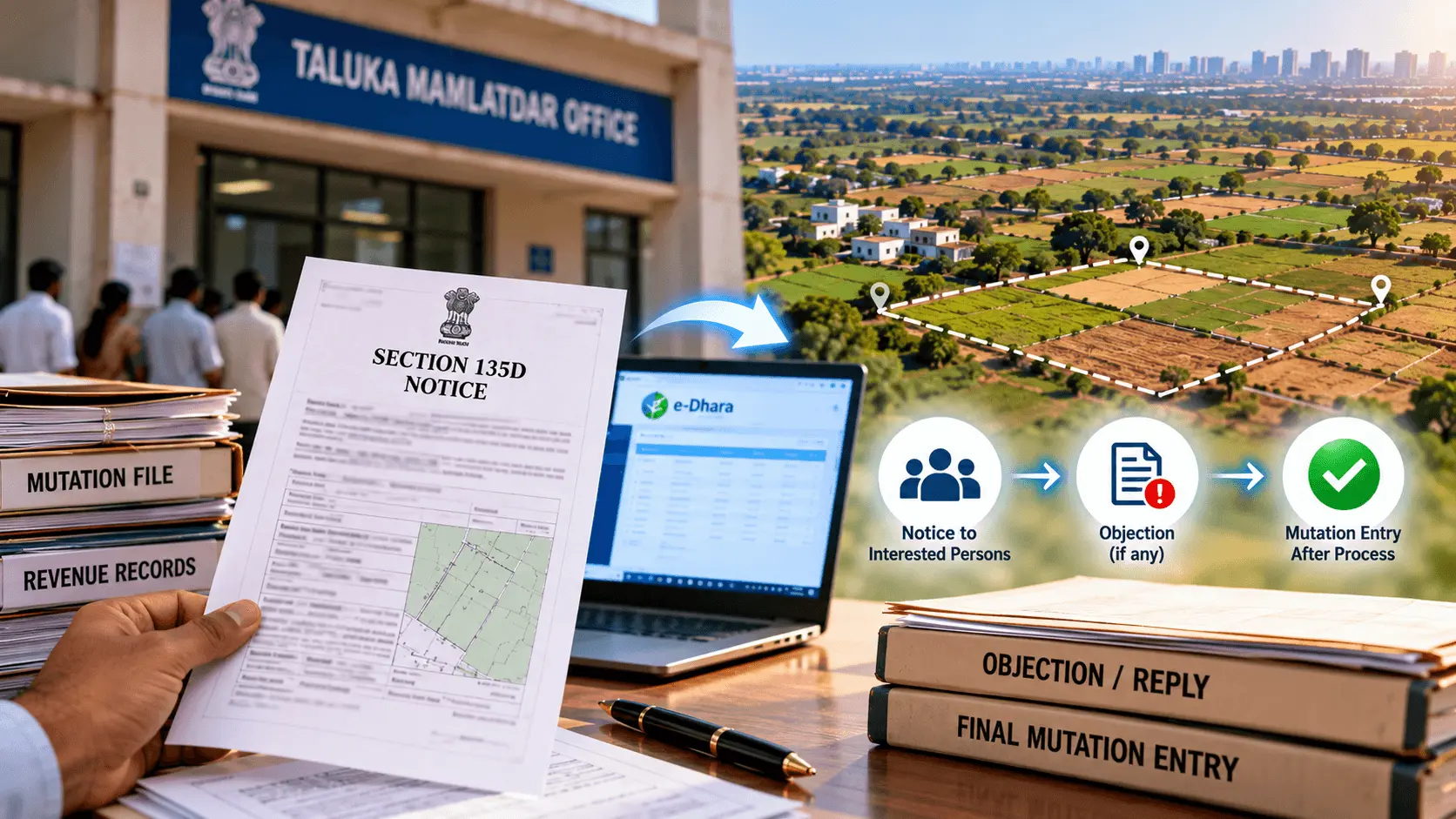
What Is a Section 135D Notice?
A mutation entry is not simply entered silently into the record.
Under the Gujarat revenue-record procedure, interested persons are notified of the proposed mutation
so that objections, if any, can be raised.
Government guidance explains that after the mutation entry is created, notice under Section 135D is
issued to persons having an interest in the change and the entry is also dealt with through the
prescribed village-revenue procedure.
This stage gives affected parties an opportunity to point out issues before an entry is certified.
For an ordinary sale transaction, the existence of the notice procedure should not automatically be
interpreted as a dispute. It is part of the mutation process.
The important question is whether an objection is actually filed and, if so, what issue it raises.
Is Mutation Completed in 30 Days?
This point needs careful wording.
The Gujarat Land Revenue Rules were amended in 2022 to provide that, for mutations other than
certain specifically identified categories, the period for raising objections is 30 days from the date of
service of the last
Section 135D notice on the interested persons.
That does not mean every mutation is guaranteed to be fully completed exactly 30 days after
registration.
The 30-day period relates to the statutory objection stage after service of the relevant notice. The total
time can also depend on notice service, scrutiny, objections, document discrepancies, the competent
officer’s decision and final updating of the computerised record.
Therefore, a buyer should not advertise or promise:
“Mutation is completed within 30 days of registration.”
A safer and more accurate explanation is:
“The ordinary mutation process includes a 30-day objection period counted from service of the
last Section 135D notice.”
How Is the Mutation Entry Processed?
The Government’s Collector Manual provides a useful outline of the e-Dhara workflow.
Preliminary mutation details are entered into the system. A unique reference is created, notices are
generated, the matter moves through the village and e-Dhara process, and the competent officer deals
with the entry after the required procedure has been followed.
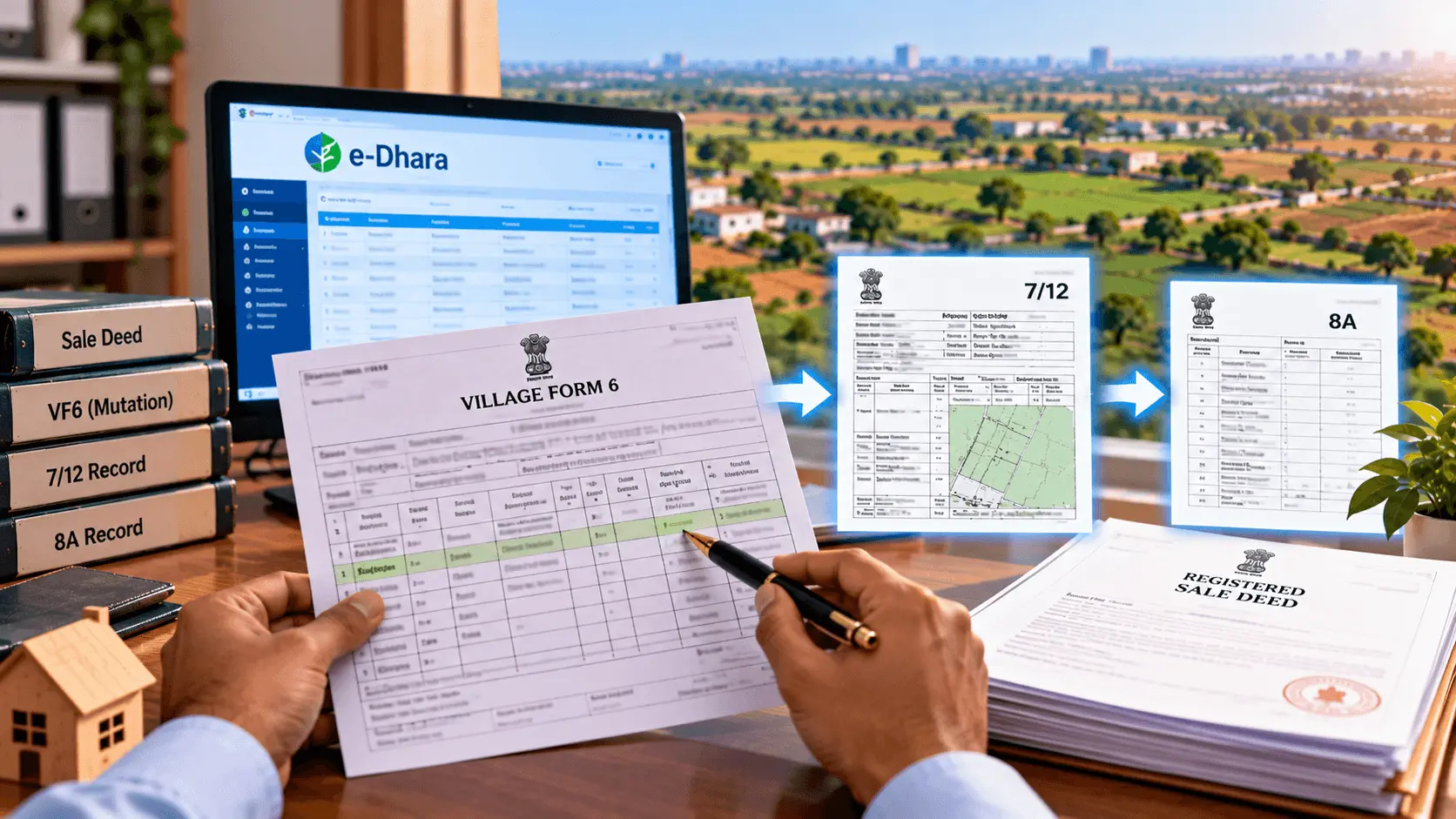
After the decision, the electronic record is updated. The official procedure refers to updated
computerised copies of Village Form 6, 7/12 and 8A being produced in connection with the completed
mutation workflow.
This is why a buyer should not stop tracking the transaction simply because somebody says “mutation
has been entered.”
There is a difference between:
Entry initiated → notice stage → objection/dispute stage if any → decision/certification →
updated revenue record.
The final check should therefore be the updated record, not only the initial entry number.
What Is Village Form 6?
Village Form 6, often referred to as
VF6, is important because it records mutation entries.
It provides the mutation trail showing changes relating to rights in the land. A buyer following a sale
deed registration mutation should therefore pay attention not only to the current 7/12 but also to the
relevant mutation entry.
The Government’s e-Dhara system provides access to VF6, 7/12 and VF8A records through the
computerised land-record framework.
This becomes useful when verifying how a change reached the current Record of Rights.
For example, if the buyer’s name eventually appears in the updated record, the related VF6 entry helps
connect that change to the mutation proceeding generated from the registered transaction.
How Can the Buyer Check Mutation Progress?
The buyer should begin with the mutation reference or unique entry number.
Government information on e-Dhara states that the land-record system can be queried for mutation
application and entry status, along with information searchable through land-record identifiers such
as khatedar name, khata number and survey number.
Gujarat’s Revenue Department also provides official online services for viewing rural Record of Rights.
The Department’s current online-service framework includes land records, document registration,
revenue applications, property cards and revenue-case information.
For Dholera rural land, the practical sequence is:
Do not rely only on a WhatsApp message saying “name transfer done.”
The Government record should show the result.
Where Is the Local Revenue Office for Dholera?
Dholera has its own Mamlatdar office within Ahmedabad district’s revenue-administration structure.
Ahmedabad District’s official website currently lists Mamlatdar Office – Dholera and the district
organisation chart places the Dholera Mamlatdar under the Prant Office Dholka structure.
This is relevant where a buyer needs to follow up on a rural revenue-record matter that cannot be
resolved from the available online record.
The officer’s personal name can change through transfers, so buyers should rely on the current official
district directory rather than an old saved contact card.
The important administrative reference is the Mamlatdar Office, Dholera.
What If the Mutation Entry Is Disputed?
If somebody files a written objection against the mutation entry, the process changes from a routine
uncontested entry to a disputed matter requiring consideration by the competent revenue authority.
If somebody files a written objection against the mutation entry, the process changes from a routine
uncontested entry to a disputed matter requiring consideration by the competent revenue authority.
A buyer should therefore never ignore an objection merely because the sale deed has already been
registered.
The first step is to understand exactly what is being challenged.
Is the objection about identity of the land?
- Area?
- Ownership?
- Seller’s authority?
- Succession?
- Survey number?
- Existing rights?
- Or a mismatch between the deed and revenue record?
The appropriate response depends on the issue. Where a substantive dispute affects legal rights,
buyers should obtain advice from a qualified land lawyer rather than treating mutation follow-up as a
routine clerical correction.
What If the Revenue Entry Differs From the Sale Deed?
A mismatch should be checked before the buyer starts using the updated record as final.
Compare the sale deed with the mutation entry and updated revenue record for the buyer and seller
names, survey/block number, area, share in the land and other material particulars.
Some discrepancies may arise from a data-entry or record issue. Others can point to a more significant
difference between the registered document and the existing land records.
Gujarat’s Revenue Department provides online revenue-application services, including routes for certain
corrections to village land records.
However, a buyer should not select a correction procedure blindly.
First determine whether the problem is:
- a simple revenue-record error
- an incorrect mutation entry
- a deed error
- a survey/measurement issue
- a title dispute, or
- a separate legal restriction.
The remedy can differ significantly depending on the cause.
Mutation Is Not the Same as a Legal Title Opinion
This distinction should remain clear throughout the article.
A mutation entry is an important revenue-record event, but checking that the buyer’s name has been
entered in the record does not replace a legal review of title.
A land lawyer may need to examine the registered conveyance, earlier title chain, revenue history,
encumbrances, tenure conditions, court or revenue proceedings and other relevant approvals.
Likewise, mutation does not by itself establish whether a Dholera property has the correct land-use or
development permission.
For example, separate questions may still exist about NA status,
TP Scheme records, Final Plot status,
planning permission or other development controls.
The purpose of e Dhara mutation Gujarat is record administration.
It should not be marketed as a Government guarantee of complete legal title.
Frequently Asked Questions
Conclusion
Dholera land mutation after registration is an important follow-up step for buyers of rural revenue
land.
Gujarat’s registration and e-Dhara systems are linked for auto-mutation after successful agricultural
land registration, but buyers should still follow the transaction through the revenue-record workflow
rather than assuming that registration alone completes every record update.
The practical approach is to retain the registered document details, identify the mutation reference,
follow the Section 135D process and verify the final VF6, 7/12 and 8A records where applicable.
One timing point is particularly important: the ordinary mutation framework includes a 30-day objection
period after service of the last Section 135D notice, but that should not be advertised as a guaranteed
30-day completion period for every case.
If an objection is filed or the updated record differs from the registered deed, the buyer should
investigate the reason instead of treating it as a routine delay.
For Dholera buyers, the best post-registration question is therefore not simply:
“Is the sale deed registered?”
It is:
“Has the registered transaction been correctly reflected in the final Government revenue
record?”
Disclaimera
This article is intended for general buyer education and informational purposes only. It is not a legal
opinion or a guarantee that a particular mutation will be accepted, certified or completed within a
particular period.
The 30-day period discussed in this article relates to the applicable objection period under the mutation
procedure and should not be interpreted as a guaranteed total processing timeline.
Mutation in a revenue record does not by itself establish complete legal title, development permission,
NA status, zoning, TP Scheme rights or Final Plot entitlement.
Buyers should compare the registered deed with the current Government revenue records and obtain
advice from a qualified advocate where there is an objection, discrepancy, title issue or uncertainty
regarding the applicable record system.
Dholera City Buildconz is an independent real estate consultancy/developer and is not affiliated with the
Gujarat Revenue Department, Ahmedabad Collectorate, Mamlatdar Office, e-Dhara or any other
Government authority.