Introduction
Choosing land for a data centre is not an acreage exercise. A parcel can be large, close to a major road and located inside an industrial planning area, yet still be unsuitable if the required power cannot be delivered, the cooling strategy has no workable water or heat-rejection plan, fibre routes are not genuinely diverse, or the site cannot accommodate the plant, fire access and future phases that the operator needs.
This distinction is especially important in Dholera in 2026. The Government of Gujarat has introduced
the Viksit Gujarat Data Center Policy (2026-29), and the policy gives the Dholera Region a specific capital-subsidy provision for eligible projects. It also deals with matters such as dual incoming power supply, open-access power, renewable-energy sourcing, water availability, captive desalination support and data-centre building norms. None of those provisions, however, should be read as a technical certificate for an individual land parcel.
The practical question for an operator is therefore different from the policy question. The policy asks whether a project can qualify under a government framework. Site selection asks whether the exact land can physically, electrically and operationally support the proposed facility. That second question must be answered with engineering evidence, not with location marketing.
This article focuses on that operator-side feasibility test: deliverable power, cooling and water, diverse connectivity, site engineering, statutory constraints and room for expansion. The examples are hypothetical. They do not certify any Dholera City Buildconz parcel, and they should not be treated as a substitute for utility, engineering or government approvals.
Start With the Facility Requirement, Not the Plot Size
A useful data-centre land study starts by defining the facility that is expected to operate on the site. The operator should know the planned IT load for the first phase, the ultimate build-out, the target construction sequence, the electrical intake that will be required, the cooling concept, the network demand and the amount of space that must remain available for later phases.
Without that base case, a statement such as “this is a 50-acre data-centre plot” has very little technical meaning. Fifty acres may be more than enough for one design and completely inadequate for another once substations, electrical yards, cooling equipment, water storage, fire systems, internal roads, security setbacks, loading areas, fuel or battery systems and future expansion are placed on the plan.
For AI-oriented facilities, this early definition becomes even more important because the operator may be planning higher-density compute and a different cooling architecture from a conventional enterprise facility. Land should therefore be screened against the intended technical design, not the other way around.
Power: What Evidence Should a Proposed Site Have?
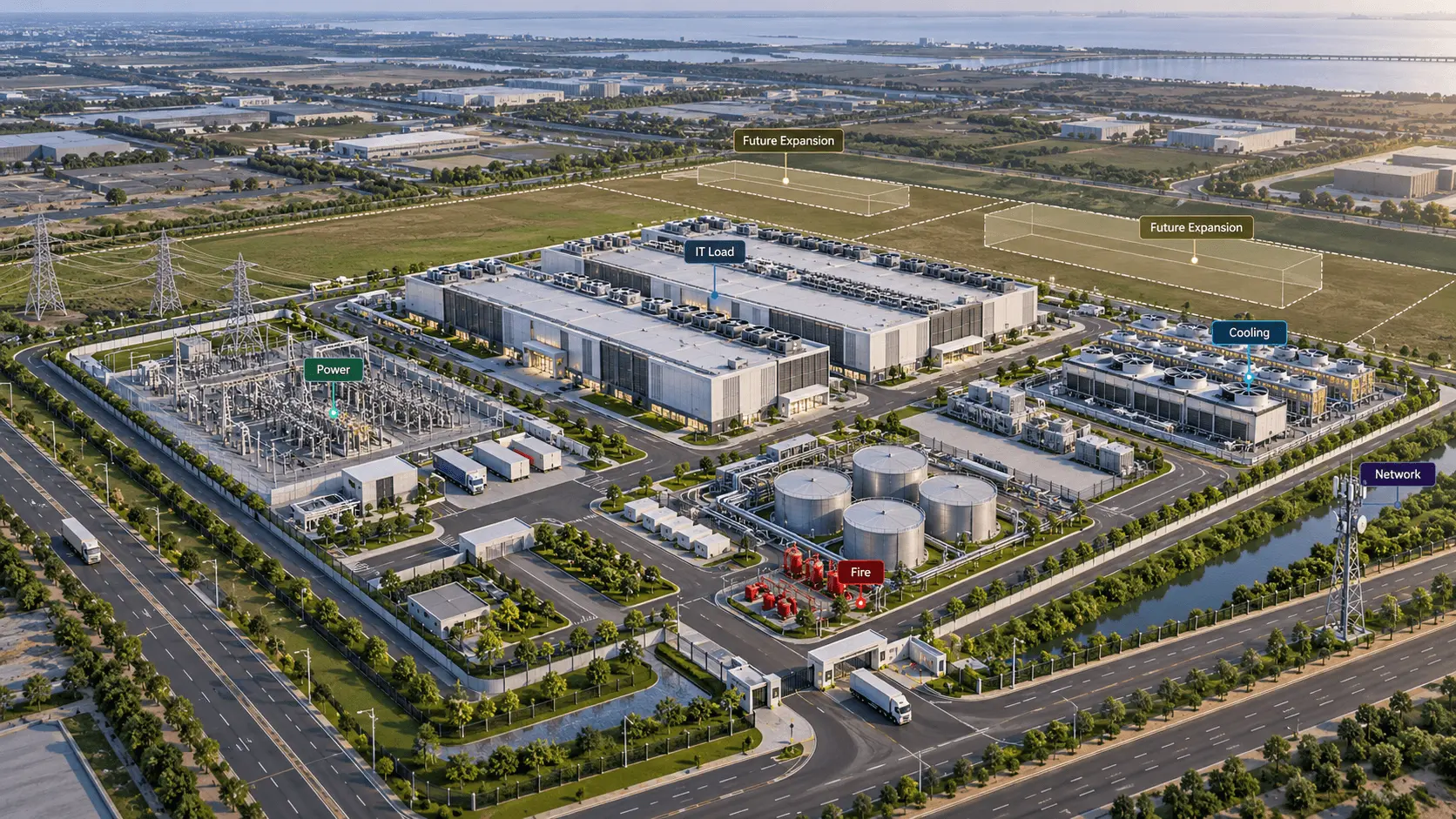
Power is normally the first hard gate in data-centre site selection. The useful question is not whether a substation exists somewhere in the region. The useful question is how much power can be delivered to the exact site, at what voltage, from which source, through which route and by what date.
The 2026 Gujarat policy is relevant because it states that the State will facilitate dual power supply to a Data Center Entity substation through two independent and electrically diverse incoming feeders from the State Transmission Utility or Central Transmission Utility network, as applicable. It also permits open-access procurement under prevailing regulations and requires at least 51% of electricity consumption for core data-centre operations to be sourced from green and renewable energy.
These are important project-framework provisions, but the operator still needs site-specific evidence showing how the proposed parcel can connect to the system.
Before a land decision is treated as technically mature, the power file should identify the requested capacity, the delivery voltage, the connection point, the supplying substation or network source, the route for incoming lines, the land needed for on-site substations and electrical yards, and the expected energisation sequence.
Where resilience depends on two feeds, the study should establish whether the routes are genuinely electrically and physically diverse rather than two circuits exposed to the same single point of failure.
The power study should also separate grid intake from the operator’s own resilience strategy. UPS systems, batteries, generators or other backup arrangements solve a different problem from long-term utility capacity. A technically strong site needs both a credible utility-delivery plan and a facility-level backup design.
For land evaluation, “near a power corridor” is therefore only a starting observation. Written feasibility, sanctioned capacity or another formal utility-stage document is far more meaningful than distance from an electrical asset on a map.
Cooling and Water Must Be Checked Separately
Water availability and cooling feasibility are connected, but they are not the same question.
A site may have access to a water network and still be poorly suited to the operator’s cooling design. Conversely, a design that reduces water dependence may create a different electrical, spatial or heat-rejection requirement.
The Government of Gujarat’s data-centre policy provides for round-the-clock water availability up to the doorstep of an eligible Data Center Entity and includes support for captive desalination plants. It also says that Data Center Entities are expected to establish captive desalination plants and meet water requirements primarily through them wherever feasible while availing policy benefits.
Those provisions show why water strategy is a project-level issue rather than a simple checkbox.
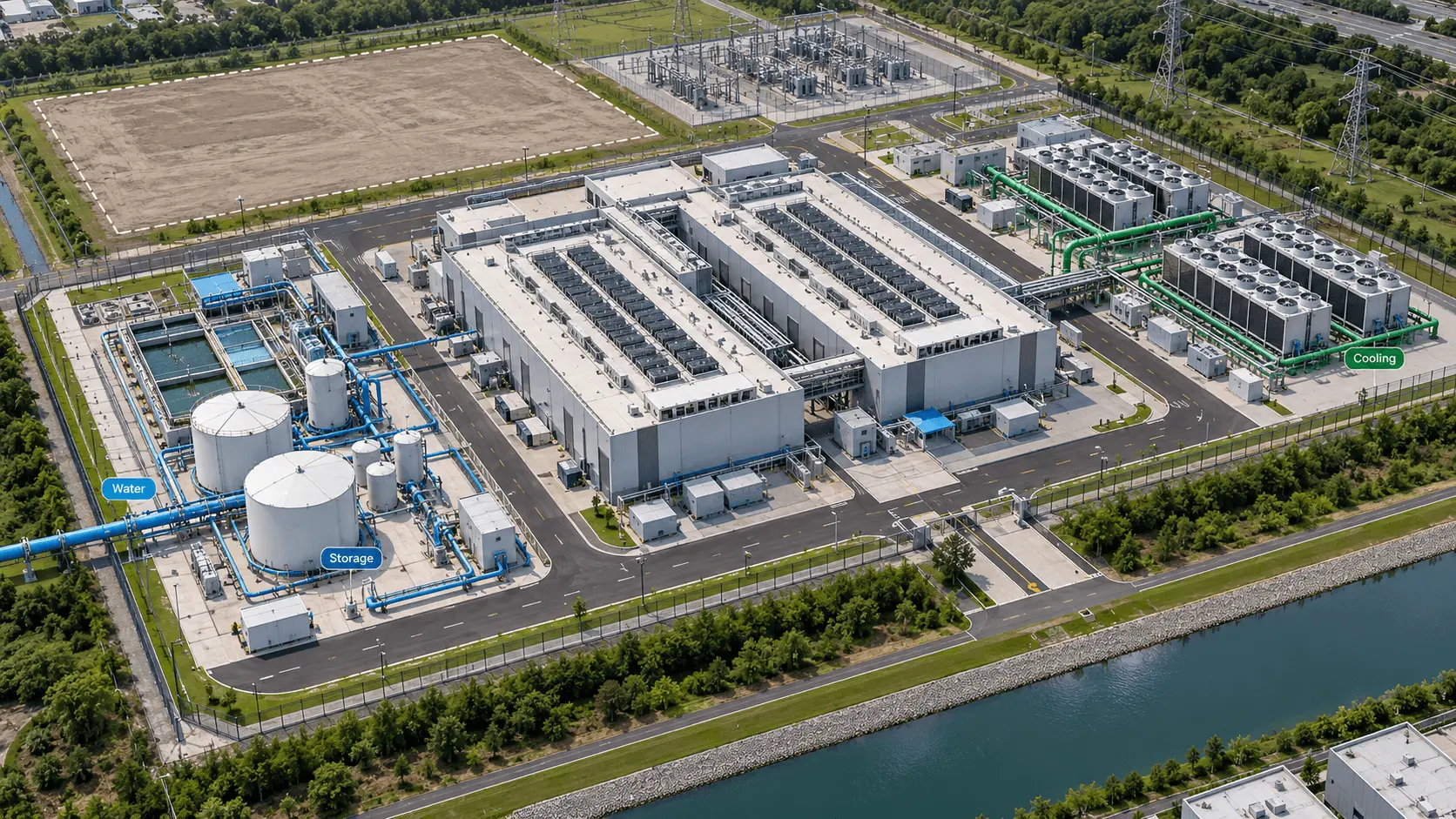
A proper feasibility study should quantify the cooling concept and then calculate the corresponding water requirement, if any. It should identify the source, available quantity, water quality, connection point, pressure, treatment requirement, storage requirement, blowdown or wastewater handling and the route by which the system will be built and maintained.
The answer should remain valid not only for phase one but also for the ultimate facility.
The cooling engineer should separately confirm whether the site has enough usable area and clearances for chillers, cooling towers, dry coolers, liquid-cooling support equipment or other heat-rejection systems included in the design.
Noise, air movement, maintenance access, structural loading and future expansion can all affect where this plant can be placed.
The correct conclusion is therefore not “water is available, so cooling is solved.”
The conclusion should be that a defined cooling system has a quantified and deliverable water, power, space and discharge plan.
Connectivity: Prove Route Diversity, Not Just Fibre Presence
A data centre must be evaluated as a network location as well as a real-estate location.
The
Telecommunication Engineering Centre’s Internet Data Centre requirements describe an IDC as a facility that should be accessible to different ISPs and other data centres and should support availability, security and network performance. For site selection, that principle translates into a practical route-diversity exercise.
The connectivity study should identify which licensed service providers can serve the site, where their nearest practical points of presence are, how each provider would enter the property and whether two proposed routes remain separated beyond the site boundary.
Two carrier names do not automatically create redundancy if both fibres use the same duct, bridge, roadside trench or common upstream route for a critical distance.
The operator should ask for route drawings or provider feasibility that can show the proposed entry points, outside-plant path, duct ownership or right-of-way assumptions, delivery timeline and scalable capacity.
The study should also consider the network destinations that matter to the operating model, such as carrier interconnection points, cloud on-ramps or other facilities, because route quality and latency requirements can differ by workload.
Official Dholera infrastructure documents include ICT and optical-fibre systems as part of the smart-city infrastructure programme.
That is useful regional context, but it should not be converted into a claim that any specific
private parcel already has the carrier diversity or bandwidth needed for a data centre. The exact site still requires provider-level confirmation.
Site Engineering Can Disqualify a Parcel That Looks Good on a Map
A technically feasible data-centre site needs more than utilities. The civil and planning envelope has to work once the full facility is drawn at engineering scale.
The first check is land use and development control.
The proposed activity must be permissible on the exact parcel, and the architect must understand the applicable building envelope, setbacks, access requirements, ground coverage, height controls and fire provisions.
The Gujarat policy includes special building support for eligible Data Center Entities, including up to 70% ground coverage, provisions relating to internal roads and fire safety, and rooftop chiller installation subject to structural safety and Airport Authority clearance.
These policy provisions still operate subject to the applicable local rules and approvals; they should not be treated as automatic rights for an unverified private plot.
The second check is the ground itself.
Topographical survey, geotechnical investigation and hydrology or drainage review should establish levels, soil and foundation conditions, storm-water behaviour and any site-preparation work needed to achieve a resilient platform.
Dholera’s official infrastructure procurement has included storm-water systems and flood-protection studies using topographic, geotechnical, sub-soil and hydrological investigation.
That does not mean a particular parcel has a flood problem. It means these are real engineering variables that should be studied rather than assumed away.
The third check is operational movement.
Data-centre construction brings heavy electrical and mechanical equipment to the site, and the completed facility needs reliable service access, fire-tender movement, secure entrances, loading areas and maintenance routes.
A narrow approach road, unresolved right-of-way, difficult turning geometry or lack of space around major plant can make an apparently attractive plot expensive or impractical.
If the building, substations, cooling plant, water systems, network entrances, security perimeter, fire access and future phases cannot all fit without conflict, the parcel has not yet passed the engineering test.
Expansion Should Be Designed Before Phase One Is Frozen
Data-centre campuses are often developed in phases, but expansion only works when the first phase preserves the corridors, land and utility interfaces needed by the next one.
A parcel that comfortably accommodates phase one can still become a dead end if later electrical or cooling infrastructure has nowhere to go.
The master plan should therefore reserve future substation bays or yards, utility corridors, cooling and water-treatment space, fibre entrances, internal roads, emergency access, storage and construction staging.
The operator should also verify that future phases can be built without putting the live facility at unacceptable operational risk.
This is particularly important when the commercial case depends on a large ultimate capacity.
The land decision should be based on the ultimate master plan with clearly defined phase boundaries, not on the footprint of the first data hall alone.
Hypothetical Examples: How a Site Can Pass or Fail
Example A - Strong location, weak power evidence
An industrial parcel sits close to a major electrical corridor and has excellent road access. The seller can point to nearby infrastructure but cannot provide a utility-stage document confirming the requested capacity, connection voltage, delivery route or timeline.
For a data-centre operator, the site remains conditional.
Power proximity is not the same as deliverable power.
Example B - Water is available, but the cooling plan is not closed
A large parcel has a water connection and ample space.
The project team has not decided whether the facility will use a water-intensive cooling design, a lower-water alternative or a hybrid approach, and there is no quantified heat-rejection or water balance.
The land should not be described as cooling-ready until the mechanical design converts “water available” into a complete operating plan.
Example C - Two carriers, one physical route
Two telecom providers say they can serve a site, but their fibres share the same roadside duct for the approach to the property.
Commercially there are two contracts; physically there may still be one failure path.
The network consultant would need a second diverse route or a different architecture before calling the site resilient.
Example D - Phase one fits, expansion does not
The first building, substation and cooling plant fit comfortably on the parcel.
When the ultimate build-out is drawn, future electrical yards block fire access and the second cooling plant occupies the only practical construction staging area.
The site may still be usable, but the master plan has revealed a constraint that was invisible in an acreage-only comparison.
What Should a Dholera Data Centre Site File Contain Before Final Selection?
By the time a parcel reaches serious operator review, the file should be moving beyond brochures and location maps.
It should contain the exact land identity and planning position, a survey and preliminary engineering layout, utility feasibility for the required electrical capacity, the proposed connection route, a cooling and water basis of design, telecom-provider route evidence, geotechnical and drainage information, the approval path and an ultimate campus plan.
The purpose of this file is not to prove that every risk has disappeared.
It is to make the remaining risks visible, owned and measurable.
A site with one unresolved issue can still be a candidate if the issue has a credible closure plan. A site with several unsupported assumptions should not be promoted as “data-centre ready” merely because it is in a growth corridor.
For Dholera,
official NICDC material confirms the wider industrial-city context, large scalable land parcels and trunk-infrastructure development in the Activation Area.
The Gujarat data-centre policy also identifies Dholera within the State’s current data-centre strategy.
Those are meaningful regional facts. The operator’s site file must still bridge the final gap from regional infrastructure to parcel-level deliverability.
Frequently Asked Questions
Conclusion
Dholera data centre land requirements should be assessed as an evidence chain, not as a list of location advantages.
The parcel has to support a defined facility, and every critical dependency – power, cooling, water, fibre, civil engineering, approvals and expansion – should be supported by project-specific documentation.
The 2026 Gujarat policy makes Dholera relevant to the State’s data-centre strategy and provides a framework for eligible large projects.
NICDC material also establishes Dholera’s wider industrial-infrastructure context.
Neither source certifies a private parcel for a particular operator. The final decision still belongs to the utility, engineering and approval work carried out for the exact site.
For an operator or land buyer, the safest sequence is simple: define the facility, verify the land use, prove deliverable power, close the cooling and water strategy, prove fibre diversity, test the ground and site layout, and only then judge whether the parcel can support the planned data-centre campus.
Disclaimera
This article is for general educational and site-screening information. It is not legal, engineering, utility, tax, financial, investment or government-approval advice.
References to policy support, Dholera infrastructure or data-centre requirements do not certify any Dholera City Buildconz parcel or prove that a particular site has sufficient electrical capacity, water, fibre, cooling feasibility, development rights or policy eligibility.
Every proposed project should obtain independent confirmation from the relevant government authorities, utilities, licensed service providers and qualified professional consultants before land acquisition or development.
Dholera City Buildconz does not guarantee government approval, policy eligibility, subsidy entitlement, infrastructure completion, future property appreciation, rental income or investment returns. Government policies, regulations, planning provisions, incentives and administrative procedures may be amended, clarified, extended, withdrawn or replaced. In case of any difference between this article and an official government notification,
Government Resolution, policy document, order or subsequently amended provision, the latest applicable official government record should prevail.