

Plot vs Flat
Plot vs Flat Which Is Better for Long-Term Investment?
Plot vs flat—which is better for long-term investment? Compare appreciation,maintenance, rental income, flexibility and key factors before buying property.Introduction
Buying property is rarely just about owning a piece of real estate. For most people, it is a decision
connected with savings, future security and the hope that the asset will become more valuable over
time.
That is where one common question comes up: is it better to invest in a plot or a flat?
At first glance, a flat can seem like the easier choice. It is a finished or under-construction property, it
can be used for living, and in the right location it may generate rental income. A plot is different. There
may be no building, no immediate rental income and sometimes not much to see beyond the land
itself.
But for a long-term investor, that simplicity can also be the attraction.
With a plot, the investment is largely in the land itself. There is no apartment structure getting older
every year, the owner has greater flexibility over future use subject to applicable rules, and a well-
located plot can benefit as development gradually reaches the surrounding area.
That does not make every plot a good investment, nor does it make flats a poor choice. The real
difference lies in what you are buying, where you are buying it and how long you are prepared to
hold it.
Plot vs Flat: Start With the Basic Difference
When you buy a flat, you are buying a residential unit within a larger development. The value you pay
for includes the apartment, a proportionate interest in the property as applicable, construction,
common infrastructure, amenities and several other components of the project.
When you buy a plot, the transaction is centred on the land.
This distinction becomes more important over a longer investment period.
Buildings have a physical life. A ten-year-old apartment competes not only with other ten-year-old
apartments but often with newer projects offering fresh construction, updated layouts and modern
amenities.
Land does not age in the same way.
A plot purchased today remains land ten or twenty years later. What can change significantly is
everything around it — roads, industries, businesses, housing, transportation, schools and the overall
demand for that location.
This is one reason long-term investors often look closely at land when evaluating real estate.
Why Plot Investment Appeals to Long-Term Buyers
The biggest strength of a plot is not that it guarantees appreciation. Nothing in real estate does.
Its strength is that land is a finite asset.
As cities grow, new employment centres emerge and infrastructure expands, the amount of well-located
usable land does not increase in the same way that new apartments can be added to the market.
Imagine two properties purchased in the same developing area: a flat and a residential plot.
After fifteen years, the locality may have improved considerably. Both properties could benefit from that
development. But the flat is now also a fifteen-year-old structure. The plot, meanwhile, is still the
underlying land, and its owner may have the flexibility to hold, sell or develop it subject to the
applicable regulations.
This difference is easy to overlook when comparing properties only by their current price.
For investors who do not need immediate use of the property and can think in terms of years rather
than months, the characteristics of land can make plots worth serious consideration.
A Plot Gives You Something a Flat Cannot: Flexibility
One of the most practical advantages of owning a plot is control over what happens next.
A flat comes with a predetermined layout. The building has already been designed, and major changes
are naturally restricted by structural requirements, society rules and applicable regulations.
A plot offers a different kind of ownership.
Depending on zoning, development regulations and approvals, an owner may choose to keep the land
vacant, build later according to future requirements or sell the property when the time is right.
That flexibility can be valuable because your needs today may not be the same ten years from now.
Someone may initially purchase a plot purely as an investment and later decide to build a home.
Another buyer may hold the land through the development phase of a location and eventually sell it. The important point is that land leaves more future decisions in the owner’s hands.

What About Appreciation?
This is where property discussions often become unrealistic.
You may hear statements such as “land always doubles” or “plots always appreciate faster than flats.”
There is no sensible way to make such a promise.
A plot in the wrong location can remain stagnant for years. A flat in a strong residential market can
perform much better than poorly selected land.
So instead of asking, “How much will this plot increase in value?”, a buyer should first ask:
“What could create genuine demand for this location over the next 5, 10 or 15 years?”
That leads to much better research.
Long-term property demand can be influenced by employment, industrial development, road and
transport connectivity, population growth, commercial activity, public infrastructure and the availability
of legally usable land.
This is why location matters more than the word ‘plot’.
Buying land only because it is cheap is not a strategy. Buying legally clear land after understanding the
location and its development potential is a very different decision.

Plot Investment Is Closely Connected With Location Growth
Consider how the outskirts of a city develop.
Initially, an area may have open land and limited commercial activity. Gradually, roads improve.
Businesses arrive. Residential demand follows employment. Shops, schools, hospitals and other
services begin to appear.
The location that once felt “far away” can start becoming part of the city’s normal growth pattern.
This is often where land investors look for opportunities.
They are not necessarily buying for what exists on the plot today. They are buying because they believe
the surrounding location has credible reasons to develop over time.
However, there is an important difference between research and speculation.
A highway mentioned in an advertisement is not enough. Neither is a proposed airport, industrial
project or development plan on a brochure.
Buyers should distinguish between what is merely proposed, what has received approvals, what is
under construction and what is already operational.
That one habit can prevent many poor property decisions.
Where Dholera Fits Into This Thinking
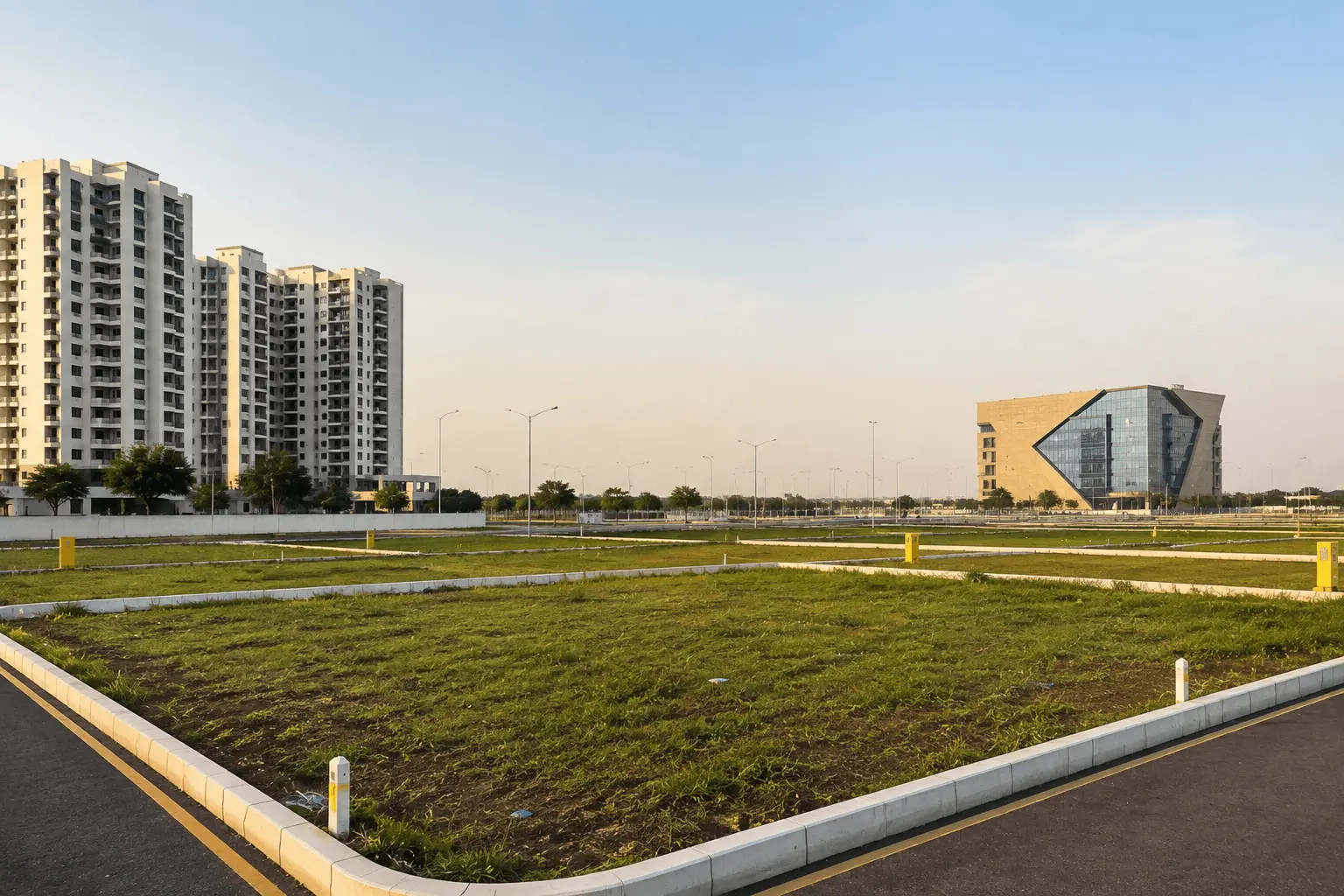
Dholera is a useful example of why some investors study planned development regions when
considering land.
It should not be viewed simply as “cheap land near Ahmedabad.” The broader investment story is
connected to the development of the Dholera Special Investment Region (DSIR) and the
infrastructure and industrial ecosystem being developed around it.
The National Industrial Corridor Development Corporation describes Dholera SIR as a 920 sq. km
industrial city and the largest node under the Delhi-Mumbai Industrial Corridor. Its official project
information identifies sectors including semiconductors, aerospace and defence, solar-component
manufacturing, green hydrogen, pharmaceuticals and heavy engineering.
The same official source states that the 22.54 sq. km Activation Area is nearing completion with trunk
infrastructure in place.
For a land buyer, developments like these matter because the long-term value of land is ultimately
connected to what creates real economic activity and demand around a location.
But this does not mean every plot carrying the word “Dholera” is automatically a good investment.
Location within the broader region, applicable land use, legal documentation, access, project status,
surrounding development and the price at which the plot is being offered all need to be checked
individually.
That distinction is important.
A strong location cannot compensate for weak property documentation, and clear documents alone
cannot turn a poorly located plot into a strong investment.

Flats Have One Clear Advantage: Rental Income
A fair plot-vs-flat comparison has to acknowledge where flats can be stronger.
A ready residential flat can potentially be rented soon after purchase. For an investor looking for regular
monthly income, that is a meaningful advantage.
A vacant residential plot normally does not produce similar rental income.
This means an investor who depends on immediate cash flow may find a ready flat more suitable than
land.
But rental income should not be confused with pure profit.
A flat can involve society maintenance, repairs, periods without a tenant, property-related charges and
periodic renovation. Rental demand also varies considerably between locations.
So the right question is not simply, “Can I get rent?”
It is how much net income remains after the actual ownership costs are considered.
For someone whose main objective is long-term capital growth rather than immediate monthly income,
a plot may therefore deserve a closer look.
The Maintenance Difference Becomes Bigger With Time
Imagine owning an apartment for fifteen years.
During that period, the property may need painting, plumbing repairs, electrical work, waterproofing,
renovation or upgrades. The building and common areas also require maintenance.
None of this means a flat is a bad investment. It simply reflects the reality of owning a constructed
property.
A vacant plot has a different cost structure.
There is no apartment interior to renovate, no lift inside the plot to maintain and no building structure
getting older. Depending on the property, an owner may still have expenses related to taxes,
maintenance, fencing, security or development charges, but the physical maintenance burden is
generally different from owning a residential unit.
For investors planning to hold property for many years, this difference deserves consideration.
You Are Not Forced to Build Immediately
A plot also gives the buyer time.
You can purchase land today without necessarily deciding today what you will build on it.
Your family size may change. Your financial position may change. The surrounding area may develop
differently from what you initially expected.
Subject to the relevant land-use rules and permissions, you can make the construction decision later.
That flexibility is difficult to replicate with an already constructed apartment.
For some buyers, this makes a plot more than an investment. It becomes a future option — land that
can potentially serve different purposes as circumstances change.
But Plot Buying Requires More Homework
The benefits of land ownership come with responsibility.
You cannot judge a plot only by visiting the site and liking the location.
Before buying, the buyer should understand exactly what is being purchased and whether the seller
has the legal right to sell it.
Important areas generally requiring verification include:
- Ownership and title documents
- Land-use status and applicable permissions
- Encumbrances or claims affecting the property
- Plot boundaries and physical access
- Applicable layout/project approvals
- RERA details where the law requires registration
- Development status of the surrounding location
- Sale and registration documentation
This is an area where buyers should avoid shortcuts.
Under RERA, the definition of a real-estate project includes development of land into plots for sale,
although the Act also contains exemptions and applicability conditions. Buyers should therefore check
whether RERA registration applies to the specific plotted development they are considering rather than
assuming that every individual land transaction falls into the same category.
Legal verification by an appropriately qualified professional can also be worthwhile before committing
substantial money.
Cheap Land and Good Land Are Not the Same Thing
One of the most common mistakes in plot investment is chasing the lowest price.
Suppose Plot A is considerably cheaper than Plot B.
That does not automatically make Plot A the better investment.
Plot B may have better access, clearer documentation, a more suitable location, stronger surrounding
development or greater future usability. Over a long holding period, those characteristics may matter
much more than the initial price difference.
This is particularly important in emerging locations, where plots within the same broad region can have
very different characteristics.
Instead of asking only “What is the rate?”, ask “Why should someone want to own this particular
land five or ten years from now?”
That question changes the way you evaluate property.
Don't Buy a Plot Only Because of One Big Project
An airport, expressway, factory or industrial announcement can attract enormous attention to a
location.
But a sensible land decision should rarely depend on one project alone.
A healthier growth story has several supporting factors.
For example, industrial activity can create employment. Better roads can improve accessibility.
Residential development can bring population. Population can support retail and services. Utilities
make further development possible.
When several factors begin supporting one another, the location has a stronger foundation than an
area dependent on a single announcement.
This is also the more sensible way to study emerging investment destinations such as Dholera: look at
the broader ecosystem, not one headline.
Plot or Flat: Think About Your Investment Goal
There is no reason to turn the plot-vs-flat discussion into an absolute contest.
A person buying a home for immediate family use may naturally prefer a flat.
Someone who wants rental income from the beginning may also lean towards a completed residential
property.
But consider a different investor.
They already have a home. They do not need monthly rental income from the new investment. They can
hold the property for several years. They want exposure to real estate without maintaining another
apartment, and they would like the flexibility of owning land.
For that buyer, a carefully selected plot starts making a lot of sense.
This is why property should be selected according to the investor, rather than expecting one type of
property to work for everyone.
Who Should Seriously Consider Buying a Plot?
A plot may suit you if you are comfortable thinking long term.
It becomes particularly relevant when you are looking for land ownership rather than immediate
accommodation, can hold through the development cycle of a location, and do not depend on rental
income from day one.
It can also appeal to buyers who want flexibility — perhaps to build in the future, hold the land as part
of their property portfolio or sell when their financial goals change.
Most importantly, a plot investor needs patience.
Land investing often makes more sense when you allow the location to develop around your
investment, rather than buying today with the expectation of selling a few months later.
So, Is a Plot Better Than a Flat?
For someone who needs a home today or prioritises rental income, a flat can absolutely be the better
choice.
But for an investor whose priority is long-term ownership, lower structural maintenance, flexibility
and participation in the growth of a developing location, plots deserve serious consideration.
There is something fundamentally simple about owning land.
There is no building that needs to remain fashionable, no apartment layout that has to compete with
the newest project and no physical residential unit ageing year after year.
What matters is the land and, even more importantly, where that land is located.
That is why the strongest plot investment is not necessarily the cheapest plot or the one with the
biggest promises.
It is usually the one where location, documentation, usability, infrastructure and purchase price
make sense together.
Before You Buy a Plot, Ask These Questions
Before finalising any plot, spend more time investigating than imagining future returns.
Who legally owns the land?
What is its approved use?
Can you clearly identify the plot and its boundaries?
Does it have proper access?
What is actually happening around the location today?
Which planned infrastructure is officially documented?
What could create genuine demand in the area over the coming years?
And perhaps most importantly: Would you still be comfortable owning this land if appreciation
takes longer than expected?
If the answers are satisfactory, you are no longer buying simply because somebody told you that “land
is a good investment.”
You are making an informed property decision.
Conclusion
A flat gives you a constructed property.
A plot gives you land — and the freedom to decide what that land may become in the future.
That difference matters when your investment horizon is long.
If you are buying purely for immediate use, a flat may solve the problem better. If you are looking for
regular rental income, again, a flat may have the advantage.
But if you are looking several years ahead and want to own a real-estate asset without tying its entire
future to an ageing structure, the right plot in the right location can be a compelling option to
explore.
The emphasis should always remain on the words “right plot.”
At Dholera City Buildconz, we help buyers explore plot opportunities in and around the Dholera
growth region with a focus on understanding location, project details and the factors that matter before
making a property decision.
If you are considering buying a plot in Dholera, speak with our team before choosing solely on price.
Compare the location, understand the project and documentation, study the surrounding development
and then decide whether the plot fits your long-term plans.
Because in land investment, what you buy matters — but where and how you buy it matters even
more.
Disclaimer
Dholera City Buildconz is an independent real estate company and is not affiliated with DICDL, DSIRDA,
NICDC or any government authority. Property availability, infrastructure status, development plans,
zoning, regulations and timelines may change. Real estate investments involve risk, and no appreciation
or return is guaranteed. Investors should independently verify property documents, government
records, approvals and current infrastructure information and seek appropriate legal or financial advice
before investing.
Still Have Questions?
Get the answers you need, quickly!