

Dholera SIR
Bulk Land Investment in Dholera : A Developer’s Feasibility Guide for 2026
Explore bulk land investment in Dholera for townships, industrial projects, warehousing and land banking. Learn costs, risks, approvals and due diligence.Introduction
For a retail buyer, property investment may mean purchasing one residential or commercial plot. For a developer, bulk land investment in Dholera is a much larger decision.
It may involve acquiring or controlling a sizeable land parcel for a plotted development, industrial facility, warehouse, workforce-housing project, commercial centre, hospitality asset or long-term land bank.
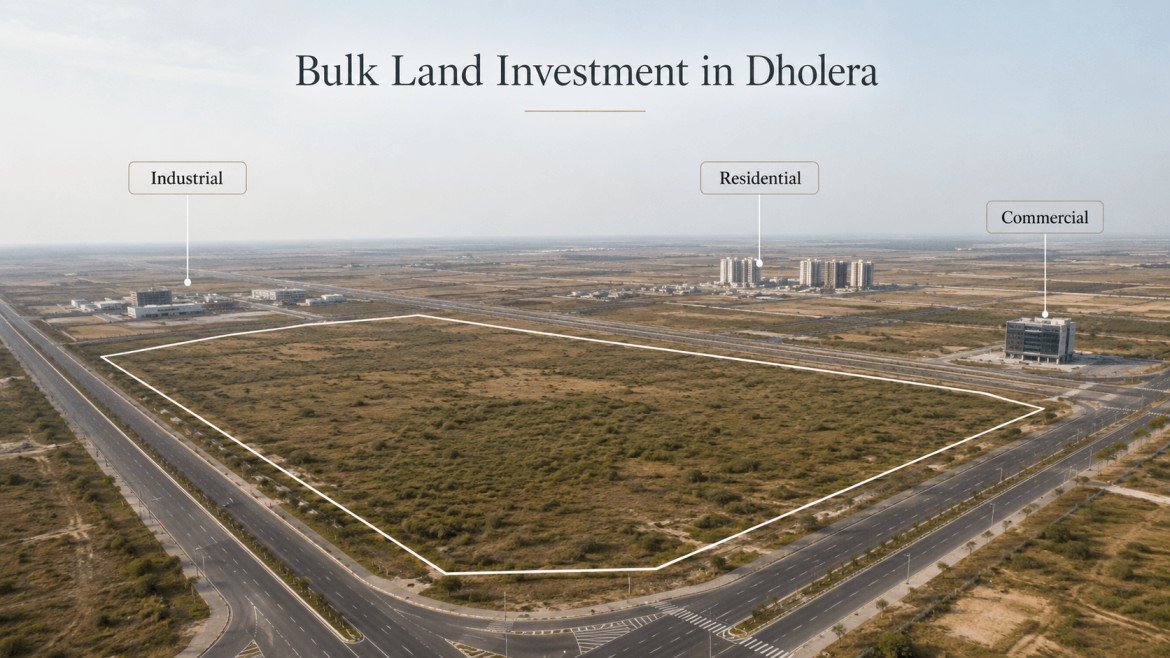
The attraction is easy to understand. Dholera Special Investment Region covers approximately 920 square kilometres across 22 villages. Around 422 square kilometres falls under Town Planning Schemes 1 to 6, while construction has been initiated across about 2,250 hectares for industrial and residential development. The official planning portal also states that parcels can be combined to create contiguous areas.
However, large size alone does not make land development-ready.
This guide explains how developers can evaluate bulk land in Dholera without depending on exaggerated appreciation claims.
What Is Bulk Land Investment in Dholera?
Bulk land investment means acquiring, leasing, aggregating or entering into a development arrangement for a relatively large parcel of land.
The exact size can vary according to the proposed project. A warehouse operator may need a different parcel from a township developer. An industrial user may prioritise utility capacity, while a residential developer may focus more on road access, social infrastructure and future population.
Bulk land can be used for:
- Land banking
- Plotted residential development
- Industrial facilities
- Built-to-suit factories
- Warehousing and logistics
- Commercial development
- Workforce housing
- Hospitality
- Educational or healthcare facilities
- Mixed-use projects
A bulk land transaction is not simply a larger version of buying one plot. It has a different risk profile, approval process, capital structure and development timeline.
Why Are Developers Studying Dholera?
Developers are interested in Dholera because it combines large-scale planning with industrial and transport infrastructure.
The region is being developed as a greenfield industrial city. Its planning framework includes industrial, residential, commercial, institutional, transport and public-use zones.
Availability of Large Parcels
Developers often struggle to assemble large, connected land parcels around mature cities. Ownership may be fragmented, roads may be narrow, and incompatible construction may already surround the site.
The official Dholera planning page specifically notes that land parcels can be combined to obtain a contiguous area. This can support projects requiring scale, although every parcel must still be checked for ownership, zoning and physical continuity.
Planned Infrastructure
Dholera’s completed infrastructure includes approximately 72 kilometres of internal roads, ranging from about 18 to 70 metres wide, along with utility corridors, water treatment, wastewater systems and power infrastructure.
The current Water Treatment Plant has a stated capacity of 50 MLD and can be expanded to 150 MLD. The Common Effluent Treatment Plant has an initial capacity of 20 MLD, while the existing power-distribution capacity is approximately 500 MVA and is designed to scale further.
These systems are particularly relevant to industrial users. However, regional infrastructure should not be confused with a live connection at every private site.
Ahmedabad–Dholera Expressway
The complete Ahmedabad–Dholera Expressway corridor was dedicated in March 2026. The access-controlled road strengthens regional connectivity and supports industrial movement between Ahmedabad and Dholera SIR.
Industrial Anchor Projects
The Tata Semiconductor Manufacturing project adds an important industrial anchor. In April 2026, the government notified a 66.166-hectare SEZ for the project, with proposed investment of approximately ₹91,000 crore and proposed direct and indirect employment of about 21,000 people.
Large industrial projects can encourage supplier, logistics, accommodation and service demand. They do not, however, guarantee the performance of every surrounding land parcel.
Airport Development
At an official review on 14 July 2026, overall construction of Dholera International Airport was reported at approximately 80%. The runway, taxiway and ATC tower were complete, while terminal work remained underway.
Airport development may support business travel and cargo movement, but developers should verify current status and local restrictions before using airport proximity in a feasibility model.
Who Should Consider Bulk Land in Dholera?
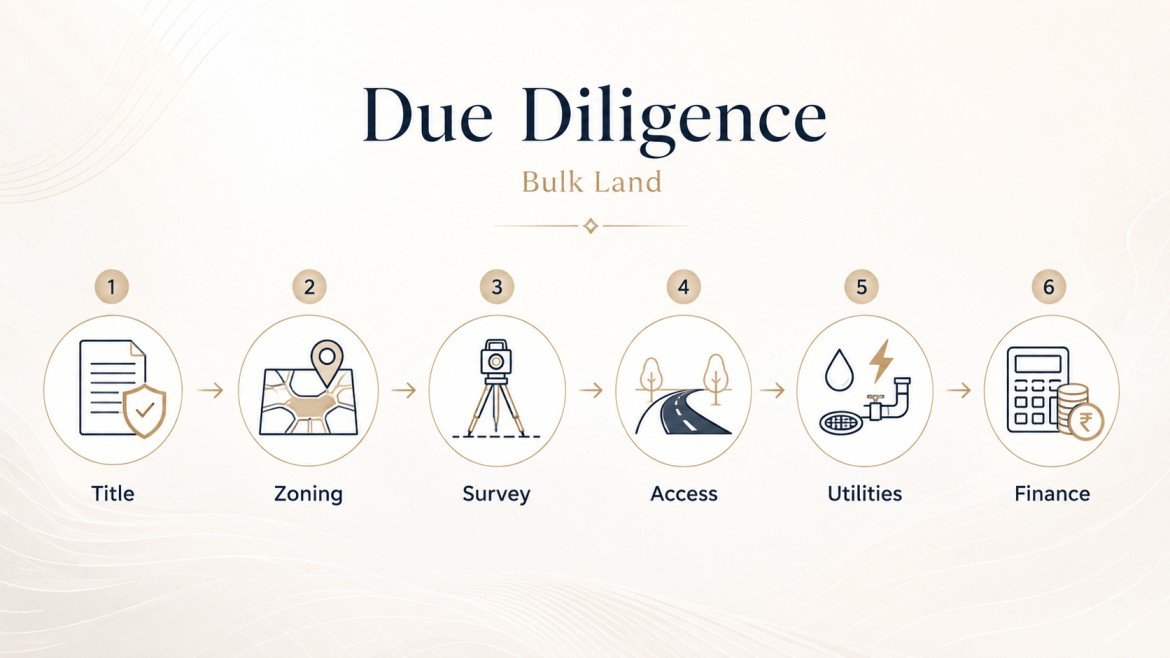
Bulk land is generally more suitable for experienced buyers with sufficient capital, professional advisors and a long planning horizon.
Real Estate Developers
Residential, commercial and mixed-use developers may consider large parcels that can be developed in phases.
Industrial Companies
Manufacturers may need land for factories, testing facilities, storage, utility systems and future expansion.
Warehouse and Logistics Operators
Warehousing projects require suitable road access, truck movement, land use, plot depth and regional connectivity.
Institutional Investors and Family Offices
Some investors may use bulk land as a long-term land-banking asset. Such investors must be able to tolerate limited liquidity and uncertain development timing.
Hospitality and Service Businesses
Hotels, serviced accommodation, food facilities and business services may become relevant as industrial activity and workforce movement increase.
Educational and Healthcare Operators
Schools, training institutes, clinics and hospitals may eventually serve employees, families and surrounding communities, subject to suitable zoning and proven demand.
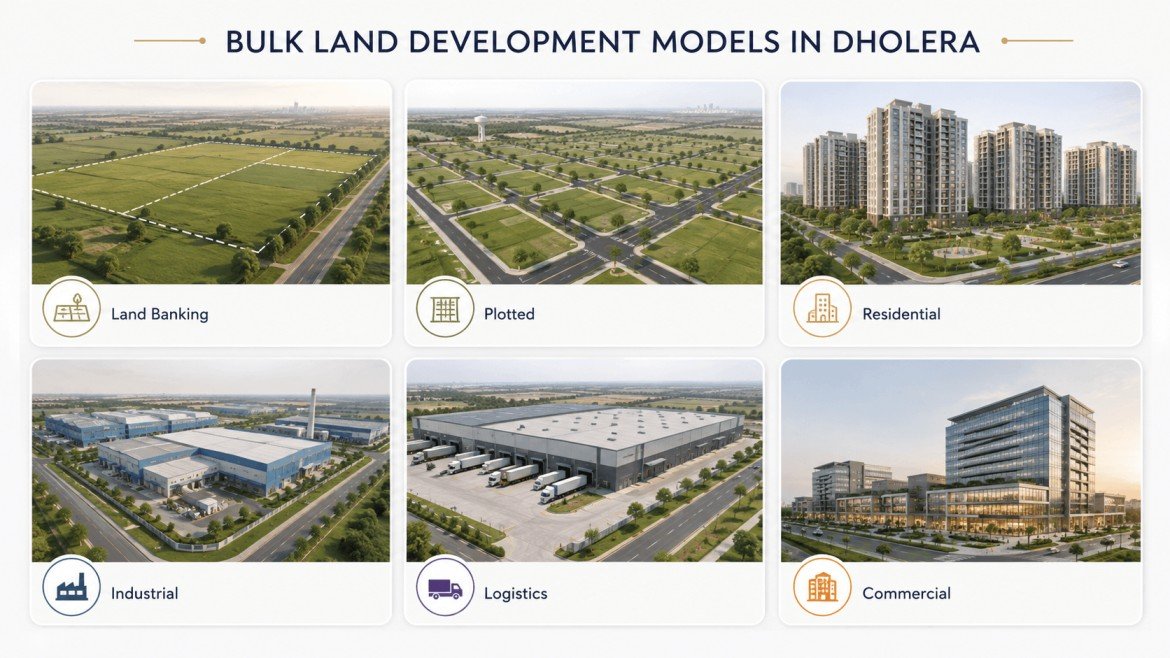
Seven Development Models for Bulk Land in Dholera
1. Strategic Land Banking
Land banking involves holding a legally verified parcel for future development or sale.
This model requires relatively low immediate construction activity but still involves:
- Capital being locked for a long period
- Security and boundary management
- Legal monitoring
- Tax and compliance costs
- Limited short-term income
- Uncertain resale timing
Land banking works best when the buyer has a defined holding period and clear reasons for selecting the location.
2. Phased Plotted Development
A developer may divide a large parcel into residential or commercial plots, subject to land use, planning permission and layout approval.
The project may be launched in phases so that early sales help fund later infrastructure.
Important requirements include:
- Clear title
- Permitted use
- Approved layout
- Legal approach road
- Internal roads
- Drainage
- Electricity and water planning
- Plot demarcation
- Customer documentation
- Applicable RERA compliance
3. Industrial Built-to-Suit Development
A developer may build a factory or industrial facility for a specific occupier.
This model requires detailed understanding of:
- Industry category
- Power demand
- Water requirement
- Effluent generation
- Environmental clearance
- Fire and safety standards
- Heavy-vehicle access
- Worker movement
- Expansion requirements
Dholera’s plug-and-play concept includes pre-planned utility systems and business facilitation, but individual industries must still obtain the required permissions.
4. Warehousing and Logistics Parks
Warehouse development may serve manufacturers, suppliers, e-commerce businesses and transport operators.
A suitable site needs:
- Direct and reliable road access
- Turning space for large vehicles
- Appropriate land use
- Efficient plot shape
- Low flooding risk
- Sufficient power
- Fire-safety access
- Labour availability
- Proximity to actual users
Being near an expressway is useful only when the property has a practical and legally usable connection to it.
5. Workforce Housing
Industrial development can create demand for accommodation for engineers, technicians, managers, contractors and service workers.
Workforce housing may include:
- Studio apartments
- Rental rooms
- Managed accommodation
- Hostels
- Family housing
- Staff facilities
The official upcoming-projects portfolio includes more than 1,000 studio apartments in a planned residential and commercial complex, indicating that workforce and business accommodation form part of Dholera’s urban-development direction.
6. Commercial and Convenience Development
As employment and occupancy increase, demand may develop for:
- Food outlets
- Daily retail
- Healthcare
- Banking
- Offices
- Business support
- Vehicle services
- Convenience shopping
Commercial land should be selected based on genuine movement and catchment—not only the possibility of future population.
7. Joint Development or Landowner Partnership
Instead of purchasing the full parcel, a developer may enter into a joint development arrangement with landowners.
Instead of purchasing the full parcel, a developer may enter into a joint development arrangement with landowners.
- Multiple owners
- Inheritance claims
- Disagreement over revenue sharing
- Authority to sign
- Project delays
- Unclear development rights
- Tax complexity
- Exit disputes
Every owner and legal heir must be identified, and the agreement must clearly define possession, approvals, revenue, cost sharing and termination.
Bulk Land vs Individual Plots
| Factor | Bulk Land | Individual Plot |
| Typical buyer | Developer, company or experienced investor | Retail investor or end user |
| Capital requirement | High | Lower |
| Due diligence | Extensive | Property-specific but simpler |
| Development responsibility | Usually with buyer or developer | May be handled by project developer |
| Infrastructure cost | Potentially substantial | Often included partly in plot price |
| Holding period | Usually long | Can vary |
| Liquidity | Lower | May have a larger retail market |
| Approval complexity | High | Moderate |
| Income potential | Requires development or leasing | May remain passive |
| Main advantage | Scale and project flexibility | Easier entry and management |
| Main risk | Capital lock-in and execution | Project, title and resale risk |
| Important Disclaimer: This comparison is provided only for general information. Actual requirements, costs, risks and responsibilities depend on the specific property, transaction documents and applicable laws. Dholera City Buildconz is an independent private real-estate company and is not a government authority. References to Dholera SIR, DICDL, DSIRDA or government planning terms do not imply government ownership, affiliation, approval, allotment or endorsement. Buyers should independently verify all property details and official records before making any decision. | ||
Expert Tips for Bulk-Land Buyers
Start with the Use, Not the Acreage
A larger parcel is not automatically better. Choose land that fits the proposed project.
Measure Net Developable Area
The gross area may be reduced by roads, reservations, setbacks, open spaces, drainage and planning deductions.
Obtain a Preliminary Layout Before Purchase
A basic planning exercise can reveal whether the site shape and access support the expected project.
Prepare Three Financial Scenarios
Use:
- Expected case
- Delayed-development case
- Low-demand case
The transaction should remain manageable under more than one scenario.
Verify Current Facts
Dholera is developing quickly. Check current official information before using airport, rail, industrial or infrastructure milestones in an investment presentation.
Avoid Guaranteed Returns
No ethical developer or advisor should guarantee appreciation from an undeveloped land parcel.
Conclusion
Bulk land investment in Dholera may offer valuable opportunities for developers who need scale, flexibility and long-term exposure to an emerging industrial region.
The opportunity is not limited to holding land. Suitable parcels may support plotted developments, industrial facilities, logistics parks, workforce housing, commercial services or joint-development projects.
But bulk land also magnifies every weakness.
A minor title issue can affect a large project. Poor access can reduce usability. Incorrect zoning can stop the intended development. Unexpected filling, drainage or infrastructure costs can change the entire financial model.
The right approach is therefore not to search for the largest or cheapest parcel.
Developers should search for legally clear, appropriately zoned and physically usable land that matches a defined customer, project model and capital plan.
Dholera’s growth story can support long-term development, but disciplined feasibility—not promotional language—should guide the final decision.
Still Have Questions?
Get the answers you need, quickly!