Introduction
As semiconductor manufacturing develops in Dholera, gases are becoming an important part of the
discussion around fab readiness. But Dholera semiconductor gas supply is not simply about having
an industrial gas producer nearby or having enough gas available in bulk. Semiconductor
manufacturing depends on the right gas reaching the right process at the required purity, flow and
condition.
This distinction matters because a chip fab uses gases in different ways. Some are required in larger
quantities for facility or process support, while others are specialised materials used inside tightly
controlled wafer-processing steps. For those applications, contamination, packaging, handling,
distribution and flow control can be just as important as total supply volume.
Government of India records confirm that Tata Electronics is developing a semiconductor fab at Dholera
with planned capacity of 50,000 wafer starts per month. In September 2026, the Government also
recorded a collaboration between Tata Electronics and INOX Air Products to strengthen the local supply
chain for high-purity gases used in semiconductor manufacturing.
That is an important supply-chain development. However, the Government announcement does not
state that every required semiconductor gas has already been qualified, that commercial delivery to the
Dholera fab has started or that a complete gas-supply system has been commissioned. Those would be
separate milestones requiring separate evidence.
This guide therefore focuses on how semiconductor gas supply actually works, why purity matters, how
specialist suppliers support fab operations and what readers should verify when future Dholera gas-
supply milestones are announced.
Why Do Semiconductor Fabs Need Specialty Gases?
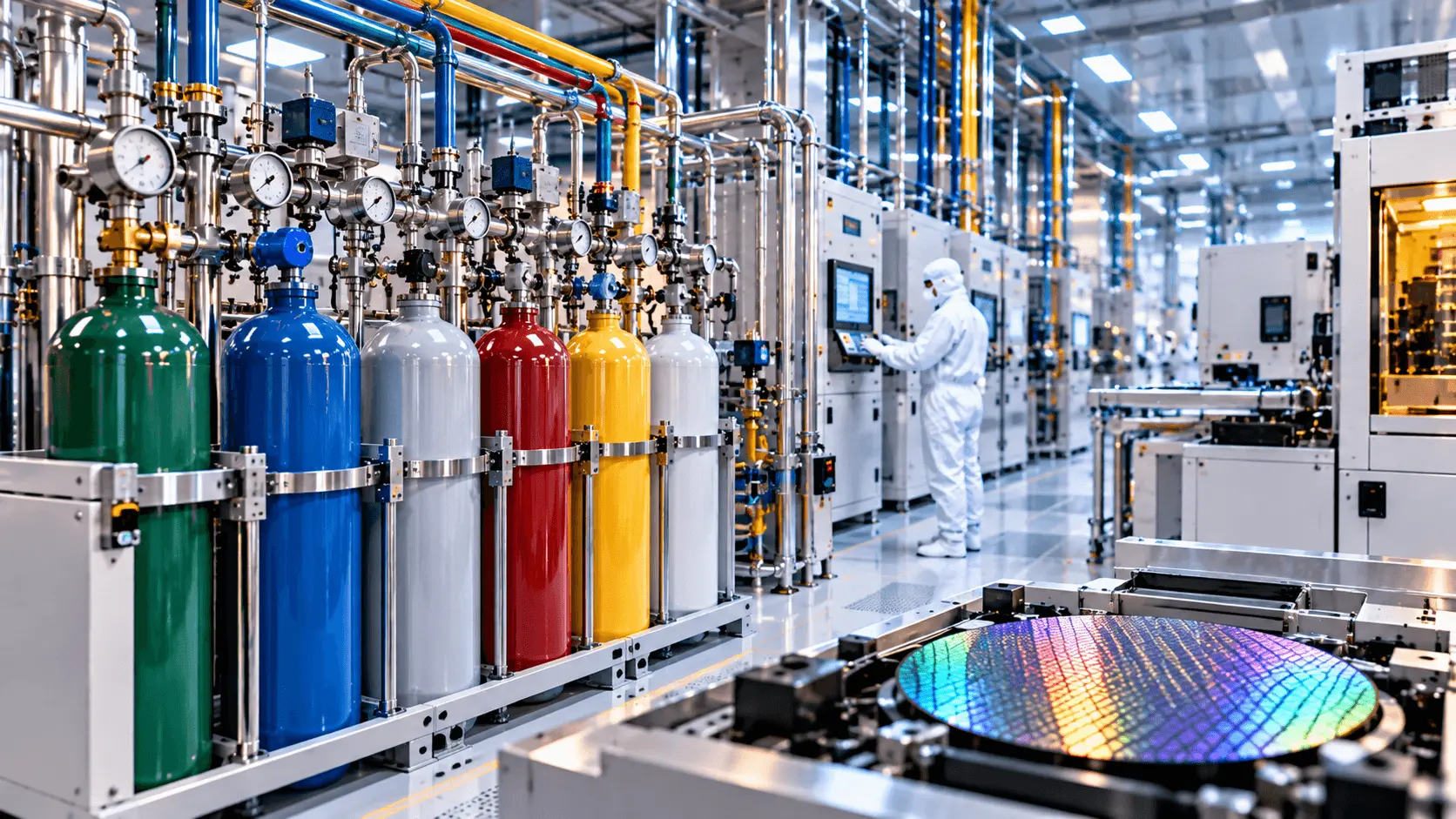
A semiconductor fab does not operate with one standard industrial gas. Different gases perform
different roles during wafer fabrication, and their requirements can vary significantly depending on the
manufacturing step.
The U.S. National Institute of Standards and Technology, or NIST, maintains technical data for
semiconductor process gases including nitrogen, oxygen, argon, ammonia, nitrogen trifluoride,
phosphine, diborane, boron trichloride and several other gases. The list illustrates how varied
semiconductor gas requirements can be, although it should not be treated as a confirmed material list
for the Dholera fab.
Some gases may support deposition, etching, cleaning or other process steps. Others may be used as
carrier, inert or supporting gases. The quantity required can also differ greatly: a fab may consume
some gases in significant volumes while using much smaller quantities of specialised process gases.
This is why electronic specialty gases in Dholera should be discussed by function and specification
rather than simply by tonnes of capacity. A large industrial gas facility may be important for supply
reliability, but capacity alone does not establish whether a material meets the requirements of a
particular semiconductor process.
Purity Is Different From Supply Volume
Supply volume answers one question: can enough material be made available?
Purity answers another: does that material contain the required gas at the required quality, with
unwanted contaminants controlled below the limits specified for its intended use?
For semiconductor manufacturing, both conditions have to be satisfied. Large supply capacity without
the required quality may not be useful for a sensitive wafer process, while an ultra-high-purity material
may still need a reliable logistics system to ensure continuous production.
This distinction is central to understanding Dholera semiconductor gas supply. When a project
announces a gas-production or storage capacity, that figure should not automatically be interpreted as
semiconductor-qualified supply. The relevant purity specification, impurity limits and customer
qualification still matter.
NIST’s work on specialty-gas analysis shows why this is technically important. Its research notes that
trace water contamination can cause process variation and defects in microelectronics, with some
applications requiring moisture measurement at extremely low concentrations.
In other words, a percentage such as “high purity” does not tell the entire story. Semiconductor users
also need to know which impurities are present, how much is allowed and how those values are
measured.
What Does Ultra-High Purity Actually Mean?
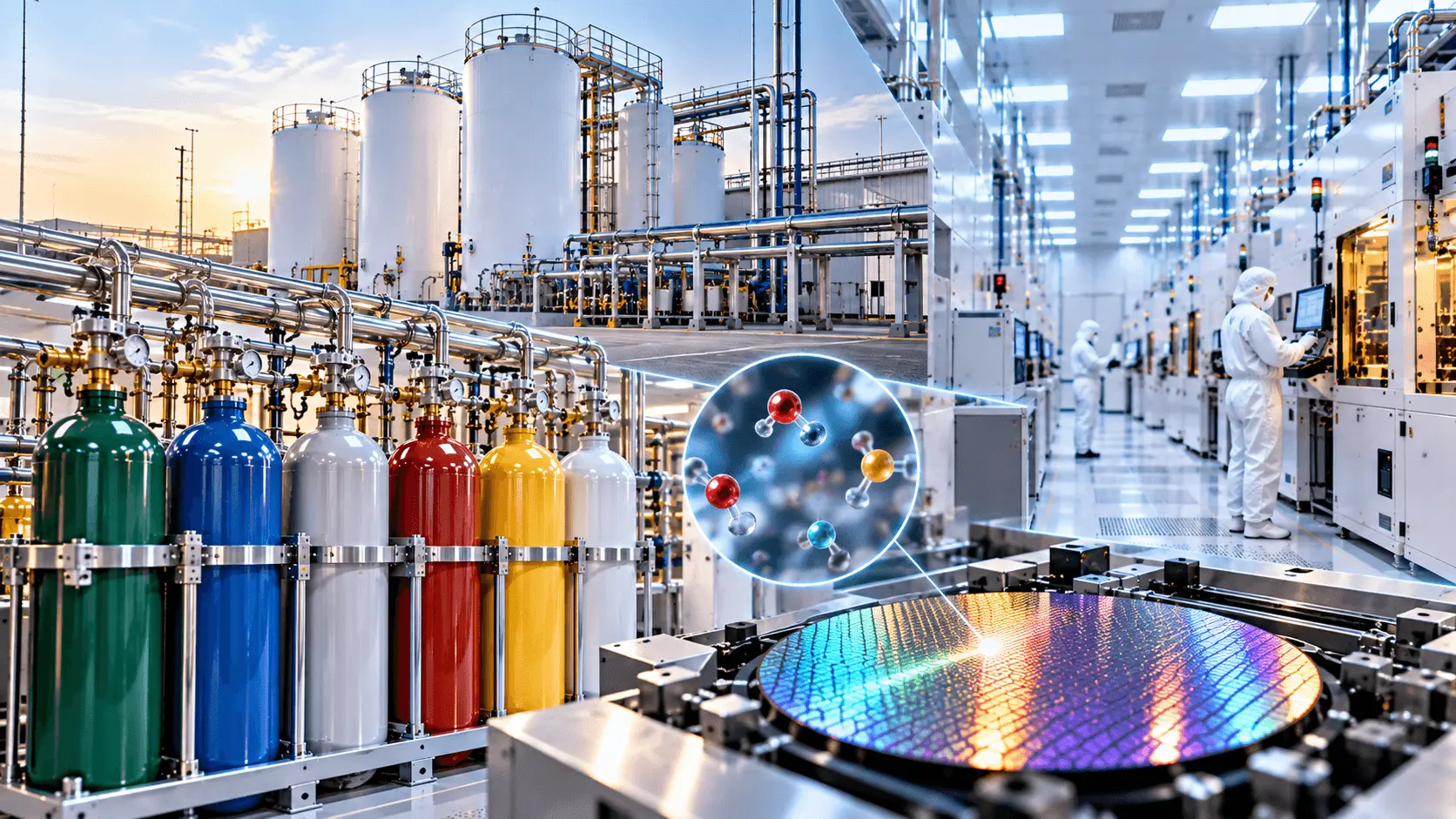
The term ultra high purity semiconductor gases is often used as though it describes one universal
specification. In practice, suitability depends on the gas, its intended application and the impurity limits
accepted for that process.
Moisture is a useful example. Even a very small concentration of water can matter in sensitive
semiconductor applications. NIST has developed trace-humidity standards specifically relevant to the
production and delivery of high-purity specialty gases for semiconductor manufacturing.
That means gas quality needs to be supported by measurement rather than marketing language alone.
The principal gas concentration matters, but so do specific contaminants and the analytical methods
used to detect them.
India’s Bureau of Indian Standards also has an Industrial Gases Sectional Committee covering
standards for industrial gases, including high-purity speciality gases and gas mixtures. Its work includes
specifications, sampling and testing methods, reinforcing the importance of measurable quality
standards in gas supply.
For a semiconductor fab, the practical question is therefore not simply “How pure is the gas?” It is “Does
the gas meet the specification required for this particular manufacturing use?”
From Production to the Process Tool
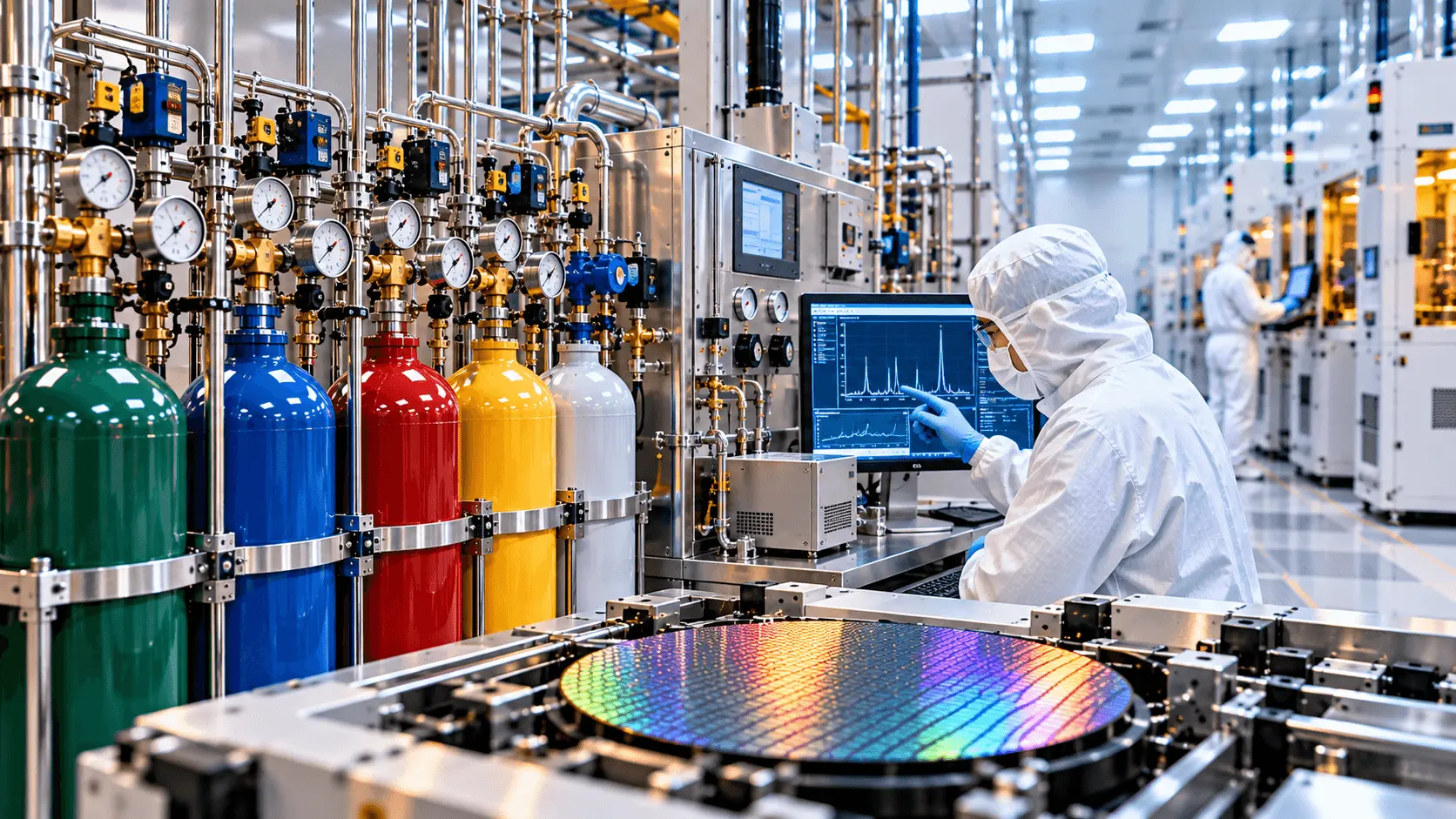
Semiconductor gas quality has to survive an entire supply chain. Producing or purifying the gas is only
the first stage.
After production, the material may need analytical verification, approved packaging or storage,
transportation, controlled handling at the receiving site and connection to the fab’s distribution system.
From there, it still has to reach the process equipment under controlled conditions.
This operational chain explains why specialist suppliers can play a larger role than merely
manufacturing gas. Semiconductor supply may involve purification, analytical control, specialised
containers, storage systems, delivery planning, high-purity piping and coordination with the fab’s
facility and process teams.
Government reporting from SEMICON India 2026 reflects this wider requirement. On September 17, PIB
reported industry emphasis on parallel investment in ultra-pure semiconductor chemicals and gases,
safe materials handling and certified domestic suppliers as necessary parts of a viable semiconductor
ecosystem.
This is also why chip fab gas logistics should be viewed as an operational system rather than a
transport exercise. Quality has to be maintained from production to point of use.

Why Packaging and Delivery Conditions Matter
A gas may meet its required specification when it is produced, but semiconductor users also have to
consider what happens during storage and delivery. Containers, valves, connections and handling
procedures become part of the supply chain.
In India, compressed-gas cylinders are regulated through the Gas Cylinders Rules, 2016, administered
by the Petroleum and Explosives Safety Organisation, or PESO. The rules cover areas including filling,
possession, approved cylinder and valve standards, storage and licensing.
PESO requirements are primarily concerned with safe and compliant gas handling. Semiconductor
process requirements add another layer: the material and delivery system may also need to satisfy
much tighter cleanliness, purity and compatibility conditions set by the fab operator.
The two should not be confused. A cylinder or storage system being legally approved does not
automatically establish that its contents are qualified for a specific semiconductor process.
This is one reason packaging and delivery conditions matter. If extremely low impurity levels are
required, gas quality needs to be protected throughout storage, transport and connection to the fab’s
distribution system.
Gas Distribution Inside a Semiconductor Fab
Reaching the fab site is not the end of the gas journey. The gas then has to move through controlled
distribution infrastructure to the manufacturing equipment that uses it.
A useful Dholera-related development was recorded by the Ministry of Electronics and IT during
SEMICON India 2026. PIB listed a Tata Electronics and Kelington Engineering collaboration covering gas
distribution systems, high-purity piping and process tool hook-up as part of efforts to accelerate fab
readiness.
This helps explain why Dholera semiconductor gas supply is not only a supplier-side issue. The fab
itself requires distribution infrastructure capable of moving process materials from the supply point to
production tools while maintaining the required conditions.
At the tool level, gas flow also has to be accurately controlled. NIST explains that semiconductor
fabrication uses mass flow controllers to regulate gases entering process chambers and that even
relatively small flow variations can affect manufacturing results and device yield.
So there are several distinct milestones: gas can exist at the supplier, arrive at the fab, enter a
distribution system and still require further system testing and process qualification before it becomes
part of stable manufacturing operations.
What Do We Officially Know About Dholera Gas Supply?
Government records provide more useful evidence now than was available earlier.
The first confirmed point is the semiconductor project itself. Tata Electronics’ Dholera fab has planned
capacity of 50,000 wafer starts per month, and Government records identify Dholera as the location of
the front-end semiconductor manufacturing project.
The second important development came on September 18, 2026. During SEMICON India 2026, the
Ministry of Electronics and IT officially listed a Tata Electronics–INOX Air Products collaboration intended
to strengthen the local supply chain for high-purity gases critical to semiconductor manufacturing.
On the same day, PIB also recorded the Tata Electronics–Kelington Engineering collaboration covering
gas-distribution systems, high-purity piping and process tool hook-up. Together, these announcements
provide Government-confirmed evidence that gas quality and internal distribution are becoming part of
Tata Electronics’ semiconductor supply-chain and fab-readiness work.
What these announcements do not establish is equally important. The PIB release does not provide a
Dholera-specific gas-by-gas list, completed supply volume, commissioning percentage, commercial
delivery start date or confirmation that every gas required for wafer production has completed process
qualification.
Those details should not be invented or inferred.
INOX and Dholera: What Can Be Said Safely?
INOX Air Products has been discussed in connection with the wider Dholera semiconductor ecosystem,
but current statements should be based on current evidence rather than older planning
announcements.
The strongest current Government evidence is the September 2026 PIB record confirming the
collaboration between Tata Electronics and INOX Air Products for the local supply chain of high-purity
semiconductor gases. That is a meaningful development and can be stated directly.
However, describing the collaboration as a fully commissioned Dholera semiconductor gas facility would
go beyond what that Government release says. The announcement establishes collaboration and
supply-chain intent; it does not publish a commercial start-of-supply date or confirm that the complete
planned gas infrastructure is operational.
The same caution applies to old investment or planning figures. A historical company announcement
may explain what was once proposed, but an old planned outlay should not be presented as money
already spent locally unless a current Government or authorised project source confirms that status.
For readers following Dholera, the useful question is therefore not only “Who is involved?” but also
“What operational milestone has actually been confirmed?”
How Dholera Semiconductor Gas Supply Should Be Verified
Future updates around gas supply should be judged by the milestone being claimed, because
production, qualification, storage and actual process use are different stages.
This approach gives readers a much clearer picture than using one broad phrase such as “gas plant
ready.”
Why Specialist Gas Suppliers Matter to Dholera
A semiconductor fab needs dependable operations over long production cycles. Gas interruptions,
contamination problems or unstable delivery conditions can affect manufacturing performance, which
means specialist suppliers become part of the operational ecosystem surrounding the fab.
The Government’s Semicon 2.0 strategy is also moving beyond fab construction alone. The programme
includes machines and materials as one of its core pillars, reflecting the need to develop a wider supply
chain around semiconductor manufacturing.
For Dholera, this means gas-sector developments should be followed as part of fab operations rather
than simply as another industrial investment headline. The important measures are quality, reliability,
qualification, safe handling, local availability and successful integration with manufacturing
infrastructure.
That is a more useful way to evaluate the role of suppliers such as INOX than repeating a proposed
investment total without knowing how much has been commissioned, qualified or brought into actual
semiconductor service.
Frequently Asked Questions
Conclusion
Dholera semiconductor gas supply is becoming a more important part of the city’s semiconductor
story, but the subject needs to be understood through operations rather than investment headlines.
A semiconductor fab requires more than gas availability. The material may need tight impurity control,
reliable analytical verification, safe packaging, compliant transportation, carefully designed high-purity
distribution and accurate flow control at the manufacturing tool.
Recent Government records now confirm two important developments: Tata Electronics and
INOX AirProducts are collaborating to strengthen the local high-purity gas supply chain, while Tata Electronics
and Kelington Engineering are working on gas-distribution systems, high-purity piping and process tool
hook-up. These are meaningful steps in building the semiconductor ecosystem around the Dholera fab.
They should still be described according to what has actually been confirmed. Collaboration is not the
same as commissioning, production capacity is not the same as semiconductor qualification, and gas
arriving near a fab is not the same as qualified gas reaching a production tool.
For future Dholera updates, the most useful question will remain simple: what exact stage of the gas-
supply chain has been completed, and what official evidence confirms it?
Disclaimera
This article is for general educational and informational purposes only.
Semiconductor gas
requirements vary according to process technology, equipment, materials, manufacturing specifications
and fab design.
References to gases listed by NIST are industry-level examples and should not be interpreted as
confirmation that every listed gas will be used at the Tata Electronics Dholera fab.
References to
Tata Electronics, INOX Air Products, Kelington Engineering or other organisations do not
imply any partnership, endorsement or commercial relationship with
Dholera City Buildconz.
Project status, supplier arrangements, commissioning dates, gas capacities, purity qualifications and
commercial delivery milestones should be verified from current Government or authorised project
records before being presented as confirmed facts.
Dholera City Buildconz is an independent real estate consultancy/developer and is not affiliated with
Tata Electronics, INOX Air Products, DICDL, DSIRDA, India Semiconductor Mission or any Government
authority.
Industrial or semiconductor development in Dholera should not be interpreted as a guarantee of land
appreciation, investment returns, rental income or future demand. Property buyers should
independently verify title, zoning, planning status, approvals and applicable Government records before
making an investment decision.